


What’s happening today?
It’s Veterans Day. The Los Angeles City Council meeting is cancelled and they won’t meet again until Friday. And there won’t be an update on election results until Friday. The LA County Registrar-Recorder/County Clerk’s schedule did initially include today and Thursday on their update schedule, but things were switched up this week.
What just happened?
Three killed as SUV crashes into food stand at North Hollywood Metro transit hub
Three people were killed at the North Hollywood Metro station on Tuesday when an SUV jumped the curb and crashed into an area on the sidewalk where street vendors are regularly set up, near one of the station’s entrances. The crash occurred around 5:55 p.m., at a time when there is usually plenty of foot traffic at the public transit hub. Three people who were injured were taken to a hospital in Northridge.
This crash happened almost two months after a driver rammed into a Metro bus in Chatsworth, killing two of the bus’s passengers (a news helicopter for NBC 4 also crashed while covering the that crash, killing the pilot and news reporter, and someone who was on the ground).
On Tuesday evening, Los Angeles Mayor Karen Bass put out a statement saying that her office was “closely coordinating with city departments as authorities work to determine what caused this horrific incident.”
“I’m heartbroken for the families of everyone impacted,” Bass’s statement said. “We will continue to provide updates as more information becomes available.”
The account for NoHo Market LA, which partners with Metro to host a Saturday outdoor market, made note of the effect the crash on the vendor community, and they offered their condolences and support. “We know what it means to put yourself out there every day to make a living the way you want to,” they wrote. “We will take any possible action we can to help the impacted families.”
LA city leaders vote to up the cost of appealing projects, despite a flurry of opposition from neighborhood groups, Unite Here Local 11
The cost of appealing a development project in the city of Los Angeles could go up by four to eight times, under an ordinance the LA City Council voted, at Wednesday’s meeting, to ask the City Attorney to draft.
The City Council signed off on recommendations by the planning and budget committees that call for the fee to go up from $229 to $1,145 for appellants who live near the project, and $2,289 for those further away. The ordinance would need to come back fot another vote by the council.
While the City Council advanced the issue with little discussion during Tuesday’s meeting, several neighborhood councils, along with others have submitted comments urging the city to reject the increase. Around 200 pages of public comment was submitted, mostly in just the last two months.
The Lincoln Heights Neighborhood Council submitted a resolution in which they said “this 413% increase is detrimental and discriminatory towards low income, disenfranchised communities, much like the communities of Lincoln Heights, Chinatown, Boyle Heights, El Sereno.”
John Urquiza, of NELA Alliance, wrote in saying “this will affect marginalized community’s ability to challenge development in their communities. Example: On the Eastside organizations such as USC HSC/SOLA campuses with aggressive expansion plans have an unfair advantage and affect nearly 1 million people, over 70% of them whose net worth falls below $55,000.”
And this letter from an attorney, John P. Given, points to changes to the city’s appeals process under Measure PL on the Nov. 3 ballot that are expected to pass, including a provision that would get rid of the seven neighborhood appeals panels and replace them with a single, citywide appeals panel of at least seven people. Given writes that “the city cannot take the action to increase fees for an appeal system that will soon cease to exist.”
Another person pointed to the proposed increase exceeding the inflation adjustment by quite a bit. And Barbara Broide wrote in saying that this fee increase was proposed separately from a slate of increases that were made recently, which means many people may not have gotten enough notice about this to properly respond. “Most community groups breathed a sigh of relief seeing that an increase in citizen appeals was not on the list of those increases recommended this year,” Broide wrote. “To suggest and propose an increase off cycle… catches many completely off guard.”
The group Unite Here Local 11, which tends to have an influential presence at City Hall, wrote in to oppose the fee increase as well, writing that the fee applies to not just appeals of housing developments, but also commercial developments.
While there was no discussion on the item before it was voted through, it didn’t necessarily go entirely unacknowledged. Council member Hugo Soto-Martinez, who used to be a Unite Here Local 11 organizer, introduced a motion proposing to exempt tenants who could be displaced by a project from paying the proposed increased fee. That motion was referred to the Budget and Finance Committee.
City officials have said that the fee increase would bring the city closer to what other municipalities charge. A city planning department report from last December compared Los Angeles’ $229 fee to those of nearby jurisdictions, like Glendale, Burbank, Long Beach, Santa Monica and the County, which had fees ranging from around $800 to around $1,000, which some had a higher range of over $2,000.
And there are some who do support the increase. The LA Times’s Itzel Luna, who reported on the council passing the motion to requesting the ordinance from the City Attorney’s Office, shared a response from Housing Action Coalition’s political organizer Victoria Gomez, who said the proposed fee increase was meant to get LA’s housing production “out of a doom loop.”
For Nithya Raman’s return to the council floor, a round of genuflection to soothe the bruises
After emerging victorious from a bruising Los Angeles mayor’s race, Nithya Raman returned to the Los Angeles City Council floor on Tuesday and was met by a round of genuflection from virtually all of her colleagues. One council member, Traci Park, was not in council chambers because she was in Washington D.C. Park had said she was reluctantly voting for Raman’s opponent, Mayor Karen Bass, and the rest had formally endorsed Bass. But Bass ended up trailing the upstart Raman by nearly 10 percentage points, as of Tuesday’s results release. Noah Goldberg of The LA Times caught the scene on Tuesday, via a table set with a pie that had the words “humble” written onto it, behind council chambers. The pie ended up in the garbage uneaten, Goldberg reported.
And for his latest carousel of portraits from inside the LA City Council chamber, photographer Eric Langberg selected a photo that juxtaposed an unsmiling Monica Rodriguez (who had especially harsh words for Raman during the election) sitting beside her longtime seat mate, a beaming Raman.
You can catch the rollercoaster of odes to the democratic process from the council members here, as each got up to offer their congratulations to Raman. Physical damage may not have been dealt. But there was some emotional damage that city leaders were trying to patch up, at times awkwardly, and they attempted to put aside the “spiciness” that occurred during the race, so that they can better focus on working together with a colleague who will soon move across the hall to the mayor’s office. It was all in the name of, and for the benefit, they said, of the city as a whole, and their constituents.
Council member Tim McOsker, one of the closers on this ritual, congratulated Raman on a “well-run campaign.” He also hinted at the disagreements that are bound to arise in a healthy, checks-and-balances relationship between the City Council and the mayor’s office.
“I just pledge to you, as we all have, that anything you need in the transition, anything you need on the floor, we’ll consider,” McOsker said. “Because, as you know, what’s really important for this city is that the City Council be the City Council and the mayor be the mayor… You are a person that knows how to find common ground, and we will find common ground on major policy issues, and we’ll find common ground on the hyper local things that are important to our constituents.”
Once the talking stick came back around to Raman, she took the time to point out one or two good qualities about each of her 14 colleagues, and then said she will commit to “carrying everything that I have learned from here and from each of you across the hallway, so that I can be the best partner that I can be to you and your constituents.”
Raman requested “the privilege” of getting a tour from each of the council members of their districts, to get a chance to find out about “areas of greatest concern, and hopefully to address them and to move forward your priorities together.”
“That is my commitment, and I hope that I have that shared commitment from all of you,” she said. In exchange, she said, she will be a “partner who understands what it means to be a council member. I get it. I know what it means to get the constituent calls. I know what it means to get the coordinated campaigns, the 100 emails in a moment about an issue that you didn’t even know about, and now it’s top of mind.
“My goal is to be a partner in the mayor’s office that helps you get answers, and to make sure that you deliver and we deliver and the city delivers the results that our constituents deserve,” she said.
A few more things…
LA county officials are being instructed to identify and name deputy gangs in the Los Angeles Sheriff’s Department, as the result of a motion the Board of Supervisors approved on Tuesday, reports Steve Scauzillo at the Los Angeles Daily News, and Connor Sheets at The LA Times. The ultimate goal of such a motion, according to some of the supervisors was to “eradicate” these gangs from the department, and to start doing that, they had to acknowledge and track their existence. The Sheriff’s department has 120 days to report back on deputy gangs.
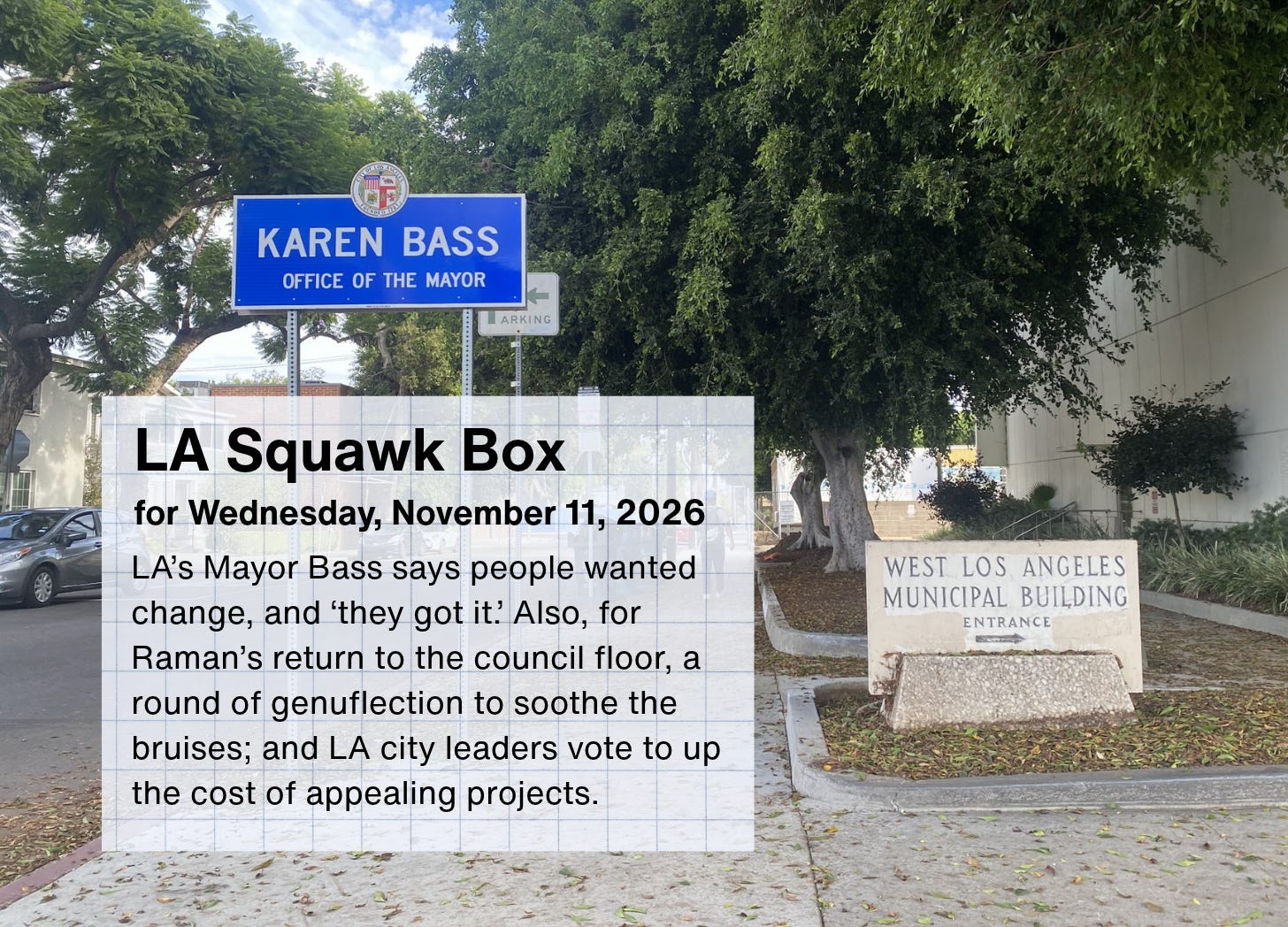
Mayor Karen Bass got interviewed by NBC’s Alex Rozier on Tuesday. She was asked what her next step was. She said she was had “lots of ideas” for that, but when asked if it was related to politics, she said, “doubtful.” Bass also said that she put the race into the national context, saying that things happen in waves, and people eventually want change. “’I’ve been around long enough to have experienced them, not where it necessarily directly affected me — but change waves happen where people are just frustrated, and sometimes they’re not always, you know… [They] just want change. They got it.”