


What’s happening today?
Wilshire Boulevard in Westlake closed to car traffic for two-day MacArthur Park to Lafayette Park festivities
A stretch of Wilshire Boulevard in Westlake, from where it cuts through MacArthur Park and down to Lafayette Park a few blocks away, is getting closed down today and tomorrow for an “open-streets” event, similar to CicLAvia, that’s called Park to Park.
And it’s part of a test-run for how it might be like if Wilshire Boulevard, where it cuts through MacArthur Park, were to be fully or partly closed, as proposed under the different options being considered for the Reconnecting MacArthur Park Initiative, an effort launched by the area’s council member, Eunisses Hernandez, that looks at the possibility of joining the two swathes of the park. The park was split along Wilshire Boulevard in the 1930s, amid a big craze for automobile travel, something that at the time felt like the next exciting and hot new thing.
These days, public transit’s cachet is returning, but in this case, the Westlake area actually has some real street cred when it comes to public transportation. The neighborhood around MacArthur Park is both densely populated, and the people living nearby depend much more on public transit than on automobiles to get around. Also, the opening festivities for the subway station at MacArthur Park was a historic and swinging affair (“Prepare to be dazzled, as we usher in a new era of high-speed transportation”) — absolutely up there with, and maybe even surpassing, the recent celebrations for the D Line extension to Wilshire/La Cienega.
These days, the park is frequently treated as a politicized flashpoint. The controversial nature of the park is something the recent report commissioned by the city to study reconnecting MacArthur Park does highlight. The report states that “the park is used as a gathering place for many people in the area, including many unhoused community members. Many park visitors express concern related to the open sale and use of drugs in the park, presence of litter, vandalism of facilities, lack of restrooms and challenges around park maintenance.”
Despite the “varying perspectives on the park’s role, value, and future in the neighborhood,” the report says, there’s nevertheless “a commonly held desire for clean, well-maintained green space, that is safe, accessible, and a great destination for families.”
The city recently finished “phase 1” of the Reconnecting MacArthur Park Initiative, which involved studying the ways people in the neighborhood use the park, as well as how traffic behaves around it. This phase essentially produced five options for “reconnecting” the park, which is a softer way of saying that it’s calling for closing a part of Wilshire Boulevard to car traffic. The tip-toe language reflects that that even the idea of closing streets to car traffic can, in many circles, stir up a political hornet’s nest, especialy since the analysis in the report, does say that most of the options would hav a “negative impact” on car traffic.
Some remarks by Council member Heather Hutt, who chairs the transportation committee, about this initiative appears to address the touchy nature of an initiative that closes a street to car traffic.
“This is a time where we’re looking at other options,” she tells LA This Week, a program that airs on the city’s official television channel. “It’s not one size fits all for the city… Having your mind open enough for what kind of options are available is how we should actually govern.”
The variations laid out in the “reconnecting MacArthur Park” report include closing the street permanently, plus an extra block out on one side, and that’s the option being recommended. There are less intensive closures that would happen only on the weekends. And there are versions that close the street off entirely to any automobile traffic, including to public transit, and another that would allow transit, but no personal cars. StreetsBlogLA has a great rundown of the five options features in the report, which is 1,100 plus pages, although about 900 of it is the detailed technical analysis on traffic.
What just happened?
No one left unheckled: LA and Lineage officials faced a tough crowd in Boyle Heights
Thursday’s community meeting in Boyle Heights to talk about the recent fire at the Lineage cold storage warehouse kicked off in dramatic fashion with a crowd bursting through the Stevenson Middle School auditorium doors, after they had marched down there from the Lineage warehouse.
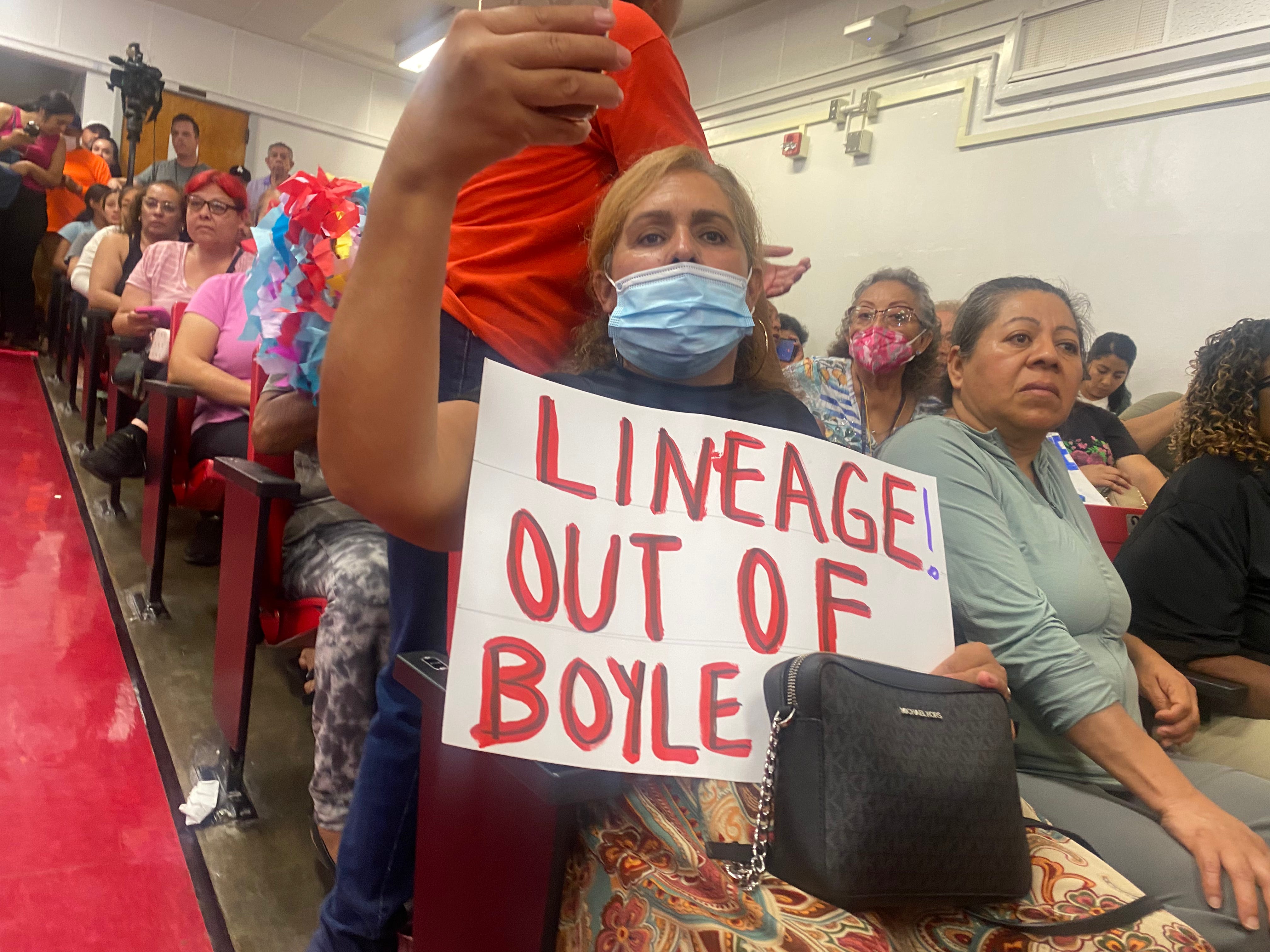
They set the tone for an evening in which audience at the community meeting, many of them from the East Los Angeles and Boyle Heights, delivered quite the dressing down to public officials and Lineage executives.
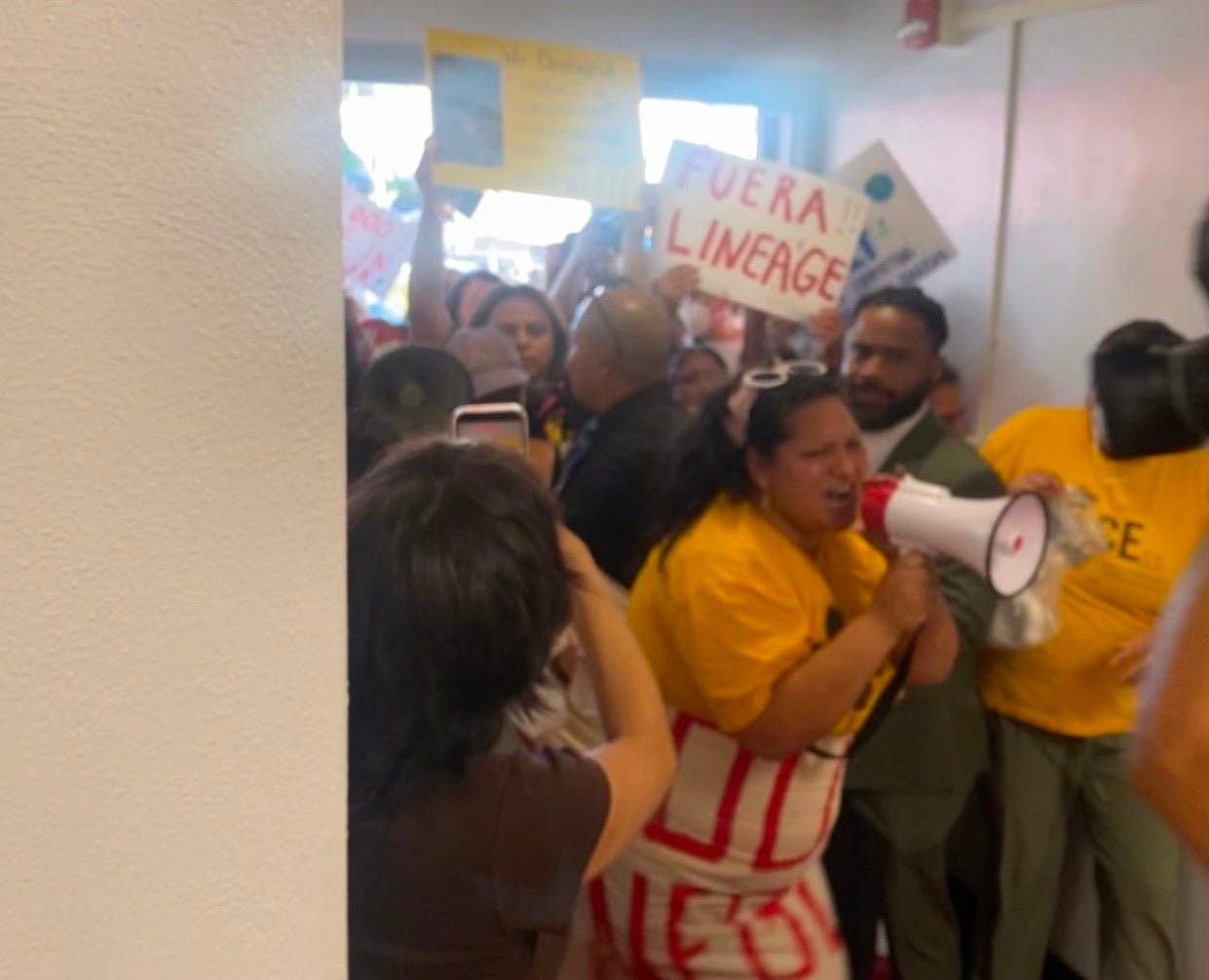
Mayor Karen Bass appeared to loud boos, as did County Supervisor Hilda Solis. Those less famous initially were spared the heckles, but eventually, LA city council member Ysabel Jurado, who represents the 14th LA City Council district where the Lineage warehouse is located, once she had introduced herself, also got hers.
As Jurado aimed to acknowledge what people in the crowd were going through, saying that they were “having to deal with uncertainty, not knowing what information to trust,” and that “small businesses have struggled with fewer customers,” several in the crowd were finding even this gesture a bit Mickey Mouse.
“You don’t have to tell us!” one said. Another snarked, “We already know.”
And when Jurado said that “this recovery is about trust,” the audience made it known that this trust wouldn’t be so easily handed over, with some shouting, “action” while another person yelled, “What’s the solution!” Throughout the meeting, community members provided commentary on the officials’ tone of voice, and their wording and subject matter choices, with one person telling them, “Don’t patronize us.”
And they consistently lectured the officials about them needing to treat the underlying matter at hand in a sober way, and with due seriousness. One person who got up to speak said that he wanted to know what the public officials and Lineage were going to do “about people that are older in age, and how this has affected them” and what they were doing for people who suffer from asthma and the effects of the toxins from the fire on people in the area. He also remarked that the mariachis that were playing outside before meeting was a “really bad call.”
“You should focus on more important things,” he said.
According to Boyle Heights Beat, the mariachi band, Mariachi Latino de José Cervantes, include members “who live near the warehouse, said the fire has hurt their livelihoods, costing them work. They also said smoke-related coughs have made it difficult to sing.”
The overall mood of the room managed to bring out some life from the normally prim and proper demeanor of the elected officials being called out. Mayor Karen Bass had to get a bit more animated to be heard, including telling people to clap to try to pull attention back to her remarks. And at one point, she disagreed with a comment from a public official who was telling people to call daily to report air quality concerns. She told that official that she was not okay with putting the burden on the public to call daily. But the mayor couldn’t escape the fact that during the meeting, many in the audience had to remind her that she had downplayed the dangers of the fire while it was still happening, when the fire smoke was at its worst, when she said at a press conference that she didn’t think the air quality was dangerous. Bass had begun the meeting hinting at that, saying that she wanted to apologize for “any confusion, miscommunication… especially anything that I have said. Whether or not the smoke was harmful was not, I am very clear all smoke under all circumstances is harmful.”
The community meeting also laid out another disconnect, this one between the company Lineage and the community around their Boyle Heights warehouse. And the company faced a special kind of wrath on Thursday, with many chanting, “Lineage out!” as part of a call for the company to close their warehouse and get out of town.
The company had early on announced that they had committed $2.5 million to the community, and that this money was going to an organization called California Community Foundation to be distributed. The company on Thursday also announced they were providing housing vouchers, grocery vouchers, prepaid cash cards, and assistance on LADWP. According to Bass, and later Abigail Marquez, the general manager of Los Angeles city’s Community Investment for Families Department, the housing vouchers were from Airbnb, and covers 400 households near the warehouse.
Rivera said the company had given the initial $2.5 million after Lineage’s CEO called Mayor Bass, who then suggested they work with CCF, which has connections with community groups, since the company “didn’t have those connections.”
“Right when the fire started, uh, we had our CEO on the phone with the mayor, and the mayor had a great suggestion, because we didn’t know what to do and who to support,” Rivera told the audience. “We partnered with CCF, right? The, um, California Community Fund. And we provided $2 million a CCO to work with the local organizations and know your community, ‘cause we didn’t have those connections.”
Since doing that, Rivera said, “what we’ve been doing, is then, listening” to see how the support has been working.
A related thing…
As public officials and Lineage executives faced a tough crowd, the LA Times’ Alex Wigglesworth was digging into why Lineage has been lobbying the city for the past year or so about a rapid shut-off system for the roof-top solar arrays that the company has blamed for setting off the fire. (Altus, the company that actually owns the solar panels, have pointed out that the cause of the fire hasn’t actually been determined yet, and that the investigation is ongoing) This shutoff device is meant to protect firefighters responding to fires, but there are also some concerns they increase fire risk. Based Lineage representatives’ account of their lobbying goal, the company had concerns about those fire risks and were trying to get approvals to install a safer alternative, which they ultimately were not able to obtain from the city.

