

What’s happening today?
What are the impacts of the proposed carve-outs to Measure ULA? LA leaders will get a report on that this morning: Proposed exemptions to the Measure ULA transfer tax would reduce funding for homelessness prevention, affordable housing and housing department staff by between $63.5 million to $144.7 million per year, according to a presentation city housing officials are expected to make to LA leaders this morning.
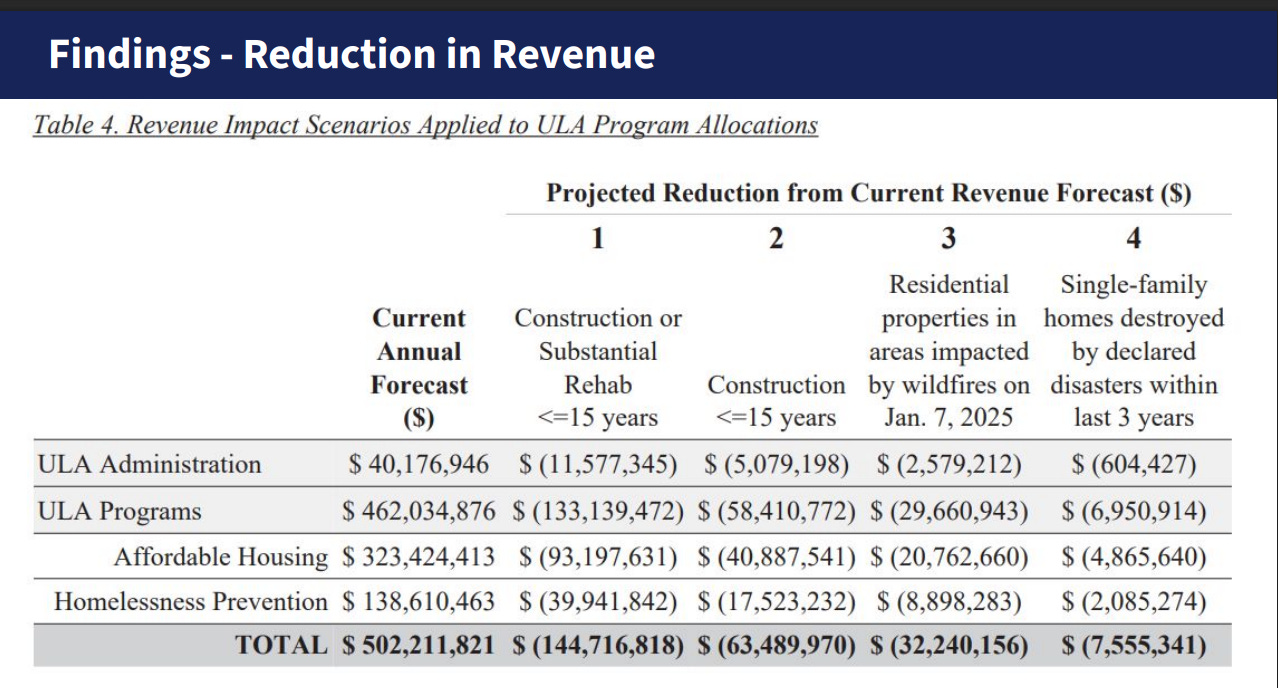
The presentation is getting heard at 8:15 a.m. in the Ad Hoc Committee on Measure ULA, which is chaired by Council member Ysabel Jurado (meeting stream). The panel, which also includes Council members John Lee and Imelda Padilla, will be getting various reports on how much revenue Measure ULA has produced, and how programs funded by the measure have fared. ULA is a tax on the sale or transfer of expensive real estate, and proceeds pay for tenant protect programs such as rental assistance and legal aid, as well as for homelessness prevention, social housing, and affordable housing construction.
A Howard Jarvis state measure threatens to nullify the measure, and that has prompted proposals to revise the tax measure, including that would exempt properties built and/or renovated within the last 15 years from the tax, which is levied when propertes are sold or change hands. The authors of the original measure, as well as tenants rights and community groups, are opposed to such exemptions and say that city leaders should really be trying to protect the tax by standing up to and defeating that Jarvis state measure, instead of taking a compromise stance.
LA city departments that offer social services to those young and old, and to assist people with getting jobs, are being merged: An LA City Council committee on efficiency is taking up legal language that would result in the creation of a new Community Investment Department, after LA leaders decided as part of last year’s budget discussions to merge three departments (Aging, Economic and Workforce Development, and Youth Development) into the Community Investment and Families Department (meeting stream, agenda).
Budget committee to resume discussion of a very lean budget: LA city leaders will be resuming budget deliberations this afternoon at the Budget and Finance Committee meeting at 1 p.m. (meeting stream). Committee members are set to hear a report that includes whether staffers were able to find funding for any of the services that are in danger of getting cut, as LA faces financial straits driven largely by rising personnel and liability costs, as well as a slow economy.
What just happened?
A proposal to give the mayor more powers in the city met with a rough reception Thursday at the City Council’s Rules committee hearing on charter reform, unsurprisingly. The response comes as a wide-ranging set of recommendations for revising the LA city charter has been transmitted from the Charter Reform Commission to the City Council to be considered for placement onto the November ballot.
Council President Marqueece Harris-Dawson, supplying a disclaimer that he is “shamelessly biased,” took issue with one idea in particular that would allow the mayor to call meetings of the City Council. He said that would be too powerful of a tool to give to a mayor, who might use it to force their will over the council.
The source of the proposal, the Charter Reform Commission, was primarily the domain of the mayor, since the executive director and other staff were selected by the mayor, and a large share of the commissioners were appointed by the mayor.
The Rules committee also discussed who should be the big boss at the Department of Public Works. There was a proposal in the Charter Reform Commission that more seriously took up giving a Public Works Department general manager real power. Right now the head of the department is the Board of Public Works, which is a five-member commission with each member filling the role in a paid, full-time capacity. But that wasn’t taken up. The City Council, anticipating needing to convince voters that such a change would truly improve city services, might be more receptive to it. The committee’s members said they wanted a stronger, more definitive proposal to improve the leadership structure at the Department of Public Works.