


What just happened?
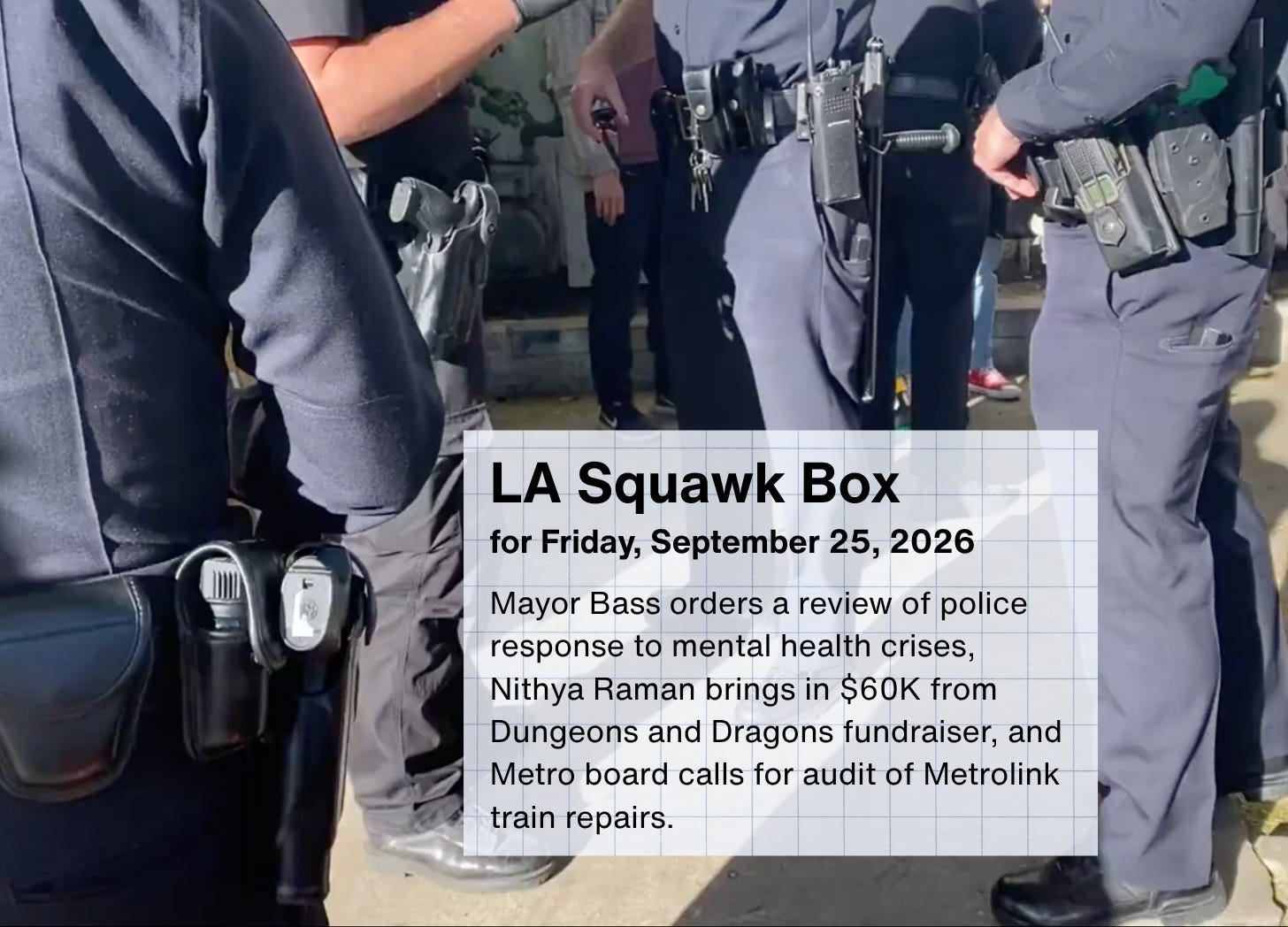
$11 million jury award among the largest for fatal LAPD officer shootings, as Mayor Bass orders a review of police response to mental health crises
A jury awarded $11 million to the family of Wilver Blanco, who LAPD officers killed while he was experiencing a mental health episode, reports Libor Jany of the LA Times. Blanco’s family had argued in their lawsuit that the police could have done more to “de-escalate the encounter, including through the use of less-lethal weapons, such as a 40mm projectile launcher.”
Jany also explains that such jury awards can get lowered if they’re appealed and “any potential settlement still would need approval from city leaders.” As it stands, the $11 million is as large of a number as it looks to most of us – it’s one of the bigger payout amounts from a police shooting, Jany writes. He cites that the largest amount in recent years was a $24 million payout to the family of a Navy vet who was killed by police in 2017.
The news about the settlement came out on the same day that Mayor Karen Bass issued Executive Directive 21, which orders a review of how the LAPD responds to calls involving a mental health crisis.
It calls for “an independent and comprehensive evaluation of LAPD uses of force and custodial arrests that result in death or serious bodily injury that may have involved individuals experiencing mental or behavioral health crises.”
But this issue didn’t suddenly become a big deal this week. It is something that has long been identified as an area of concern, going even further back than this 2024 analysis by Robert Garrova of LAist that found that a third of LAPD shootings since 2017 involved someone who was experiencing a mental health crisis.
That article references LAPD reports that already talks about how they do train officers in de-escalation. And it features City Council member Eunisses Hernandez speaking out about a lack of funding for an alternative way of responding to people who are in a mental health episode.
Hernandez told LAist in a statement that “we continue to see that alternate crisis response teams are not funded at the levels needed to support Angelenos experiencing mental health crises. We will continue to see these preventable shootings unless we invest in community based mental health services and alternate crisis response teams at the scale needed at both the city and county level.”
Bass’s new directive also references a lack of funding, and it includes language that says “decades of systemic disinvestment in mental and behavioral health services have created a severe shortage of care, leaving individuals in acute crisis with virtually nowhere to turn. As a result, individuals with untreated mental illness or behavioral health crises too often experience repeated encounters with law enforcement, or cycle between the streets, emergency rooms, and detention facilities and eventually end up in the criminal justice system.”
The LAPD’s mental health crisis is also a subject that LA City Controller Kenneth Mejia has studied. His office issued a report in October 2025 detailing the results of their audit of the LAPD’s mental health unit, known officially as SMART. One of the larger conclusions they made was that on those teams, clinicians tended to play second fiddle to officers who called the shots. And alongside the push to find funding for unarmed crisis response models, the LAPD is also expected to try to secure more funding for its own units.
Mejia’s report states that “LAPD constantly requests additional funding for more SMART units to respond to mental health calls. However, if LAPD continues to relegate SMART to a secondary and supportive role instead of a lead role during mental health calls, there will be no mitigation against use of force and deadly outcomes.”
The Los Angeles City Council earlier this week also touched on the alternative model that Hernandez, who provided the statement to LAist in 2024, champions. The council forwarded along a couple of motions related to building out an alternative system, which is now currently more in a pilot stage, called the Unarmed Model of Crisis Response. Hernandez commented on the fact that one motion relates to the use of settlement fund stemming out of the opioid crisis to pay for this alternate model.
“I’m grateful for that work and the innovation around using dollars that are coming from a lawsuit that came about because people were getting rich off selling opioids that started the opioid crisis and bringing that back to support our community,” Hernandez said. “I’m grateful for that innovation … so I hope that you all can support these so that we can continue to build out and beef up our public safety ecosystem by increasing our unarmed crisis response system to be citywide and full capacity.”
A few more things…
In a filing covering a recent 80 day span, from July 1 until Sept. 19, Mayor Karen Bass raised more than Nithya Raman, but Raman has the most money on hand in the last month before poll close on Nov. 3, and with ballots getting mailed out in just two weeks, on Oct. 5. The heavy lifting, for both candidates, has been done by public matching funds, with Raman maxing out with $1.5 million in such funds, and Bass now with just under $1 million. Bass has gone through more funds than Raman. Her campaign spent $1.39 million, while Raman has spent $706,714. Raman’s campaign, notably, hauled in $60,000 on a single night just before the deadline on Sept. 19, during a Dungeons and Dragons-themed fundraiser featuring comedian Brennan Lee Mulligan.
The LA Times has a story about how the recent Berkeley poll, which gives Raman a staggering 11 point lead, puts pressure on the Bass campaign to go negative. It explores how polling functions in an election contest, with some commenters they consulted saying that it can make it more difficult for Bass to convince donors to put more money into her campaign. Polls can be inaccurate or may not be truly reflective of what voters really will do, but they nevertheless hold sway over the tactics that campaigns feel like they have to employ to stay in the game.
Steve Scauzillo of Southern California News Group reports on a motion approved by the Metro board to perform a comprehensive audit of repairs of Metrolink trains and potential safety issues related to that. The rail agency is seeing reduced ridership that’s contributed to a budget shortfall.