


What’s happening today?
Eleventh-hour decisions to reform LA City Hall continues this afternoon in a special meeting set for 1 p.m. in the LA City Council’s Rules Committee. The commission met last Friday to discuss other issues, but delayed discussion of police accountability until today’s meeting, with the committee’s chair (who is also the LA City Council President) Marqueece Harris-Dawson, saying that the committee member who is championing the issue, Hugo Soto-Martinez, was absent. They did take comment from Council member Eunisses Hernandez, the other major champion for the proposals for increasing the accountability of the Los Angeles Police Department. The committee is also set to take up a motion on allowing noncitizen voting on local elections. The City Council has until tomorrow, June 17, to decide what to place on this November’s ballot.
What just happened?
LA City Hall reform continued at a glacial pace last Friday, as LA city leaders reject 25-member City Council proposal
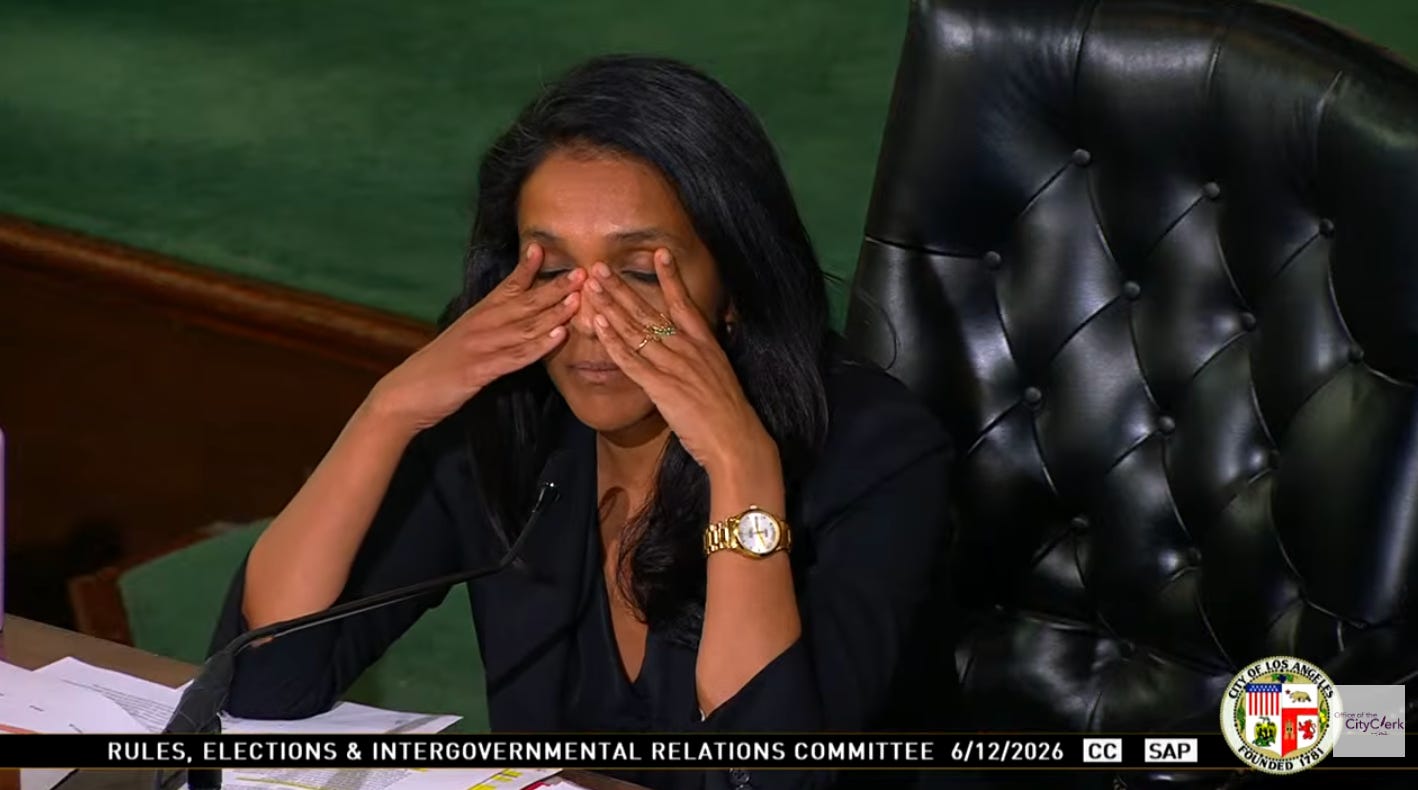
Some of LA’s most powerful leaders last Friday rejected a proposal to expand their members to 25 people, just four days ahead of a June 17 deadline for placing council-sponsored initiatives onto this November’s ballot.
The Rules committee, which includes the City Council president and the council’s budget chair, ducked out on placing the proposal on the November ballot, after receiving a city report recommending that further study be done and the issue be placed instead on the November 2028 ballot.
This issue of expansion was originally punted by a 2023 ad hoc committee of the City Council that also included powerful members of this body, with the promise that a separate charter reform commission would further study the issue. Three years later, the promised study of the issue never materialized — including one that got answers to basic questions such as what the duties of a 25-member council would look like and how much this change would cost.
Some committee members nevertheless spoke to the strong arguments for expanding the council, which has been capped at 15 members since its inception, — now more than a century ago in 1925 — with each member now representing more than 260,000 constituents, a population larger than many cities.
Council member Katy Yaroslavsky, who sits on the Rules committee and is budget chair, said that “one of the strongest arguments for expansion is access to power.”
“Running for council in LA requires an enormous amount of money, organization, political infrastructure,” Yaroslavsky said. “When each district is this large, the barrier to entry gets higher. More often than not, the clearest path belongs to people who are wealthy and/or well-connected, and that’s not the sign of a healthy democracy.”
Yaroslavsky ended up not supporting the proposal, saying that the study needed in order to present the issue to voters has simply not been done.
Council member Nithya Raman was the sole committee member who advocated putting the issue to voters in November, arguing that LA leaders have “been discussing this for three years, and we have not had the further study that is required.” She pointed to the earlier 2023 punt, which came with the promise that council expansion would be studied by the Charter Reform Commission.
That process, Raman said, “was supposed to be the real process for arriving at those answers.”
Raman, who is running for mayor, has argued that the city needs better leadership to ensure city services are delivered in a way that works. She said that while expansion may not be the answer to all of the problems that LA faces, “it is an answer to one piece of it, which is your accessibility to your local elected representative and your opportunities for better representation.”
Raman pushed back on this latest effort to delay the issue, saying that she wants to “make sure that we have a clear pathway. I thought we had one before. And we don’t.”
City Council President Marqueece Harris-Dawson, who is considered a close ally to Mayor Karen Bass (who is facing off against Raman as she runs for re-election), argued that there has been some progress, even if it is “painfully slow.” He said that while their own ad hoc committee back in 2023 couldn’t get to a specific number for how many people to expand the City Council by, and were only able to come up with a range, the charter reform commission did decide on increasing the council to 25 members.
The status quo ‘political machine’ at city hall? ‘They don’t even care,’ says City Controller Kenneth Mejia
Controller Kenneth Mejia, who just cinched a second term in office, took to his soapbox this weekend, posting on social media about his disappointment at the charter reform process, including the Rules committee’s decision to punt on council expansion, ranked choice voting and several changes his office proposed to increase the independence and influence of the controller’s office.
“LA City Hall continues to disappoint and frustrate me. But what else is new?” Mejia said. “This is the status quo of the political machine working, wanting to maintain its power.
He said that when it comes to the controller’s office recommendations, which include making the controller the chief financial officer, and protecting their office’s budget, which weren’t even considered, “they don’t even care.”
Parks advocates to keep fighting for a bigger protected budget for Rec and Parks
LA City Council member Katy Yaroslavsky proffered some of the more convincing arguments on another charter reform issue on Friday, when she said that the city’s recreation and parks services are “wildly” underfunded and that she was tired of the city’s parks ranking last. But Yaroslavsky again gave some disappointing news at last Friday’s Rules committee when she said that there was simply no funding to pay for parks — either because there hasn’t been the political will to put a tax measure on the ballot, or because they also simply aren’t prepared as a City Council to reduce the funding of the LAPD so that more funds could be allocated to parks.
Yaroslavsky remarked that while people might say the funding for parks should come out of the LAPD budget, most of that budget is salaries, and city leaders have had trouble keeping those costs down.
“I don’t think this council, when faced with the actual choices, is prepared necessarily to reduce LAPD by the amount” needed to fund Recreation and Parks under the proposed increase for parks,” Yaroslavsky said.
Advocates for protecting the Recreation and Parks department’s budget say that multiple attempts to raise money through tax measures have petered out, and they see the proposal Yaroslavsky placed on the table Friday as insufficient. Yaroslavsky put forward a proposal that instead of doubling the amount, would increase it by 50%, which translates to around $175 million each year. Yaroslavsky argued that they could study putting another tax measure on the ballot in 2028 to reach the fully doubled amount.
Meanwhile, Recreation and Parks Department Jimmy Kim told the Rules committee that not a week goes by that they don’t get requests from council offices about parks services. They try to do their best, Kim said, “but the simple fact of the matter is it’s breaking the backs of our staff.” Parks are closed on Sundays, he says, and any amount would help.
The Trust for Public Land recently released rankings that placed Los Angeles’s parks 93rd, dropping from 91 the previous year.
Council members Jurado gets heat for insufficient notification of encampment sweeps in Skid Row
Last week, amid the wider conversation about registering unhoused people to vote, and the intimations that this was a cynical, exploitative effort to skew the results of the LA mayor’s race, Council member Ysabel Jurado spoke up in defense of unhoused people’s right to engage in elections.
Notably, Jurado pointed out that “the people most affected by decisions about housing, policing, sanitation, and city services should have a voice in those decisions.”
Interestingly, Jurado herself has been getting some heat from unhoused constituents in her district, which includes Skid Row, over how city services are being handled. Jurado represents the 14th District, which has the city’s highest number of unhoused constituents, given that Skid Row is located within its boundaries.
Sweeps in Skid Row, a 50 block area where homeless services as well as encampments have been sequestered (the area was officially conceptualized as a “containment zone”), are conducted under a city program called Operation Healthy Streets, which covers a wide geographic area. That means that people living in encampments there need to prepare for such sweeps, which require them to move their encampments, without knowing if the crews will really come to their block that day.
And last Friday, General Dogon, an organizer with LA CAN (Los Angeles Community Action Network), urged LA leaders that, if such sweeps are even to be done, there’s a need for better notification procedures, especially ones that are at least equal to the CARE+ sweeps that take place in other neighborhoods in the 14th City Council District, where the geographic areas being targeted are smaller.
During the public comment portion of Friday’s City Council meeting, Dogon said that “nearly every day, we get members (of Los Angeles Community Action Network) telling us about the traumatic and violent impacts these sweeps are imposing on them, and through all the stories, one thing that’s always consistent is [there is] no notice, or… not enough time to retrieve they stuff, and so while the council office claims to work with LAPD and the bid to coordinate sweeps., the only people who don’t know that the sweep is happening is your constituents on a block, right?”
LA CAN members and organizers sent Jurado a letter about a month ago, and they say that they haven’t received a response from her office. The LA Reporter just sent an email late Friday, also asking about the public comment.
An LA CAN member, Queen AJ, also spoke, saying they’ve never spotted staff from Council member Jurado’s office doing outreach and monitoring the sweeps, “nor have we seen you before, during, or after to see how people’s lives were dramatically impacted once you allow the sweeps to happen.”
“So, while we are 100% against sweeps happening at all, at the very least, can we get the same treatment for other communities… which includes sufficient notice for the sweeps?” Queen AJ said. “I would ask, why do we not deserve that, but I’m going to give you an answer, we deserve that. Do something, Councilmember Jurado.”
Jessica, another organizer with LA CAN, said in their public comment on Friday, that their members have been making comment at LA City Council meetings every week. “At least respond to our letter,” Jessica requested. “Why has your office not replied?”
The letter from LA CAN requested that Jurado’s council office “provide specific notice of the date and time of the ‘clean-up’ at least 48 hours in advance and that, once noticed, they actually conduct the ‘clean-up.’ This is the norm in every other neighborhood in CD14 and across the city, and must be the norm in Skid Row as well.”
“As we discussed in our meeting, the permanent metal signs that say there may be a cleaning on a given day of the week somewhere over a several square block area do not provide sufficient notice,” the letter continues. “A block may go weeks or months without cleaning, while people living there, many of whom have disabilities, pack and move their tents and other possessions each time. Or, one day they fail to move their belongings and the Sanitation Department comes and destroys them. Or, not having had specific notice, they leave the area to go to work or an appointment and lose their possessions.”

