


What’s happening today?
LA county officials will be taking up a presentation on the effects of a merger between Paramount and Warner Brothers during a Workforce and Economic Development Cluster meeting at 2:30 p.m. County officials on Wednesday released a report that projects big job losses if the merger were to happen.
What just happened?
How Karen Bass and Nithya Raman handled LA’s housing politics at the Sherman Oaks mayoral debate
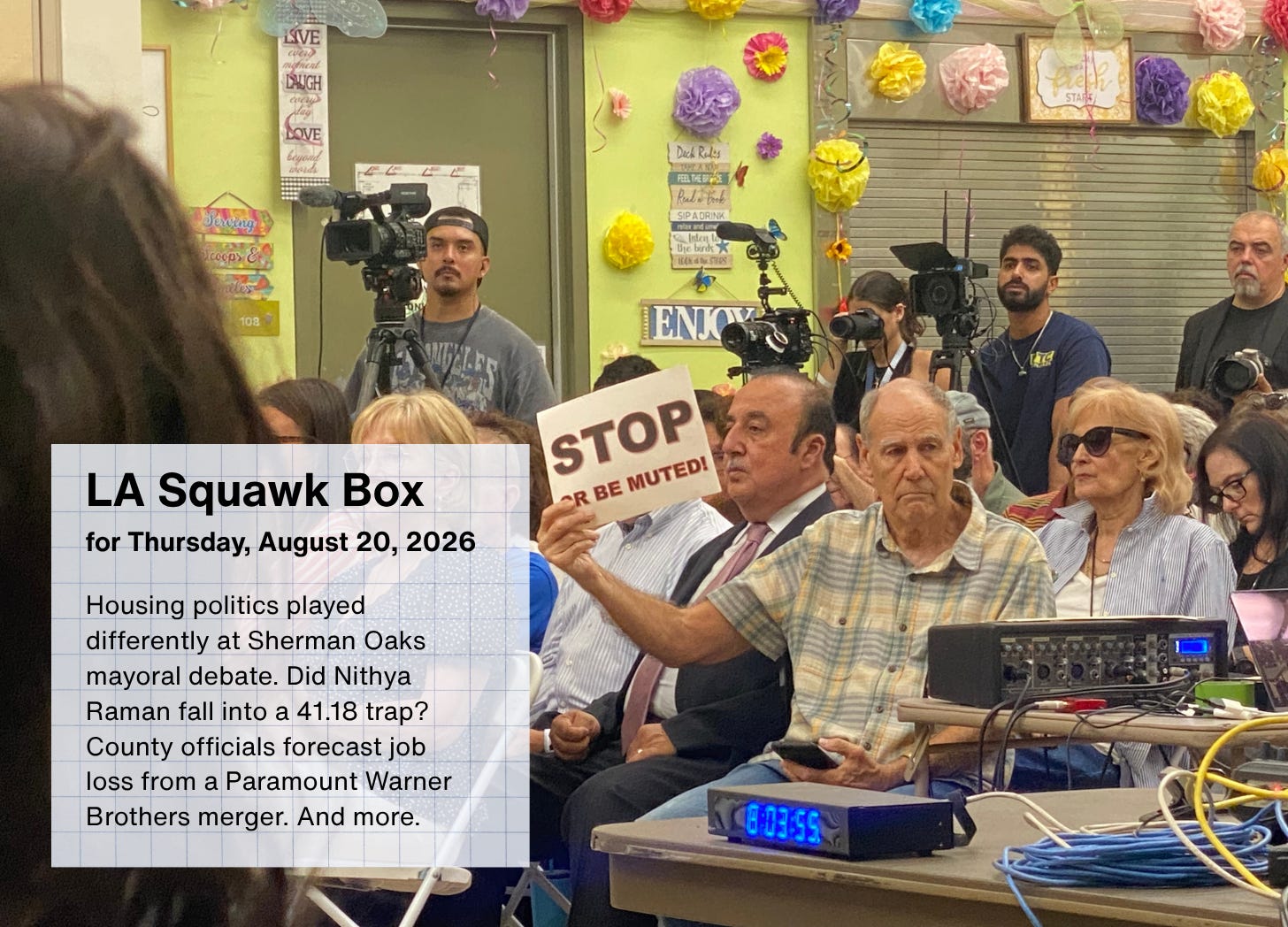
At the end of Wednesday night’s mayoral debate hosted by Sherman Oaks Homeowners Association, I caught the tail end of a conversation in which a woman carrying a Karen Bass sign explained to a man in a Carpenters polo her position that single-family housing in Los Angeles needed to be protected.
That man – who is part of the Carpenters union that recently endorsed Nithya Raman – responded that the problem for him, though, was that this meant that his children wouldn’t be able to afford to stay in Los Angeles. They then wrapped up their conversation cordially and went their separate ways.
That conversation mirrored one of the big differences between the two mayoral candidates over the course of the debate, which was largely organized by the Sherman Oaks Homeowners Association, a group with a long history of painstaking advocacy against increasing building density. Bass’s stances align with SOHA’s, and Raman is more predisposed to pushing back against slow growth policies and supports more housing to be built.
But there appeared to be another difference during the debate, which was held at the Sherman Oaks East Valley Adult Center, that revolved around how each candidate interacted with the homeowner group, which has had a significant influence on LA’s politics.
“What I learned from you all when I was running – what the Sherman Oaks Homeowners Association does, I think, is a model for other places in the city – [is] you do not want high rises in your single family streets,” Karen Bass told the older, mostly white audience in the room, many of whom are members of the homeowners association. A line like this tends to unlock a happy purr from a group with SOHA’s bent — and Bass had also doused that statement with flattery.
Meanwhile, Raman – who tends to diverge from SOHA’s stances – tried to widen the aperture. Whenever she was asked about how she would protect single-family homes against efforts that have led to those being “eviscerated” under SB79, she responded that the city has not been putting in the work – such as changing the zoning and planning policies – to ensure that state lawmakers stay out of their business.
“The attacks on single-family homes will continue to come the longer this city shies away from its responsibility to build,” Raman said. “We should go up there [to Sacramento] and tell them how we want to accommodate more neighbors in this city. How do we want to solve our housing shortage? And if we take it seriously, they’ll take us seriously. Right now, they’re not taking us seriously.”
The full debate is now posted on SOHA’s YouTube page.
So did Nithya Raman fall into a trap set up by the 41.18 vote?
Mike Trujillo, a political consultant who favors Mayor Karen Bass in the mayor’s race, has recently been describing Council member Hugo Soto-Martinez’s motions to rescind his district’s 41.18 zones, as an intentional trap for Bass’s opponent Nithya Raman.
“I humbly thank Hugo Soto Martinez for setting up a vote so the entire world can watch how Nithya Raman votes to allow homeless encampments back at these sites, 3rd degree chess here,” Trujillo wrote last week. And on the morning of the Sherman Oaks Homeowners Association debate Wednesday, Trujillo wrote that “Hugo had a job to do, forcing Nithya Raman to be on the RECORD re-opening an unmitigated disaster of more homeless encampments.”
So did Raman fall into the trap during Wednesday’s debate? About 20 minutes in, Fox 11 newsman Phil Shuman, who was serving as debate moderator, took up the vote on Soto-Martinez’s motion, asking Raman, “Under what scenario is it not safer for our children, for ourselves, to move crazed drug-addicts away from schools?”
Raman responded that this was a “scenario where they’re not on the street at all. And that’s the solution that I’ve been pushing for.”
Raman said that the 41.18 resolutions, which set up anti-encampment zones, “at its most effective, uses scarcity resources to move an encampment 500 feet down the block. I think we can do better.” She said that city resources could be used instead to “end homelessness.”
Raman then pointed to the steep drop in homelessness in her district, as captured by the annual homeless count, saying that “we reduced street homelessness by 49% over the past few years that I’ve been in office” and that RVs and tents have been reduced by 70% as evidence that “this is possible to do.”
“But we have to have a bigger imagination than thinking that the best that we can do in Los Angeles is to think about which block an encampment should be on,” Raman said. “We should be removing encampments from our streets completely.”
By the way, Soto-Martinez, who carried those motions to rescind the anti-encampment zones in his 13th council district, is in the same progressive voting bloc as Raman, but maintained his endorsement for Bass when Raman entered the race. Some have made a big deal out of the fact that Raman doesn’t have the support of even her progressive colleagues.
Traci Park mistakes a lefty Abolish 41.18 campaign as DSA-led
Whether feigned or genuine, there seems to be a tendency to conflate every lefty or progressive group with one another. Council member Traci Park – who earlier this week voted against Council member Hugo Soto-Martinez’s motions to rescind his predecessor’s 41.18 anti-encampment zones – characterized “Abolish 41.18” as a campaign led by DSA. But that is not the case, according to one of those groups.
“When the DSA shows you what they are, believe them,” Park had written as part of a post that shared slides from Mutual Aid Union LA, which is calling for more progressive council members to repeal pre-existing zones, and for the council to repeal 41.18 entirely. Park was among the council members who sees the 41.18 law as beneficial, rather than harmful.
“Hey Karen, we’re glad you could take time out of your busy schedule tormenting poor people to confuse us with DSA, a group that is in no way affiliated with this campaign,” says a post from LA Street Care, one of the groups involved in the campaign, to set the record straight. “One question tho: Why are you crashing out over our demand that the city actually house people?”
In the original slides, Mutual Aid Union LA is described as a “direct action-based network of autonomous mutual aid organizations.”
Altho it isn't the same thing, somebody at least ought to point out to LA StreetCare that if they put up some post with the word
SOCIALISMI -- (?) -- people might confuse them with DSA. I lived through the 60s Liz. I know what it was that actually made a difference in making changes that were positive. None of this s*** is or will.