


What’s happening today? Charter reform is being taken up by the Rules committee at 1 p.m. They’re focusing on the topics of budget, infrastructure and procurement. Some of the motions on the agenda relate to the Port of Los Angeles, the Board of Public Works and the budget for Recreation and Parks. (meeting stream)
What just happened?
New polling in the mayor’s race shows Rae Huang in last place: Emerson College Polling released new survey results for the mayor’s race that puts Mayor Karen Bass in the lead with 30%. Spencer Pratt trails at 22%, followed by Nithya Raman at 19%. Adam Miller and Rae Huang both come in at single digits, with Miller at 7% and Huang at 4%. Emerson College also provided a link to a spreadsheet with the full results that breaks down the demographics and politics of the respondents. Out of the 1,000 people surveyed on issues that ranged to the governor’s race, 350 were voters in Los Angeles. The LAT’s write up on this is here.
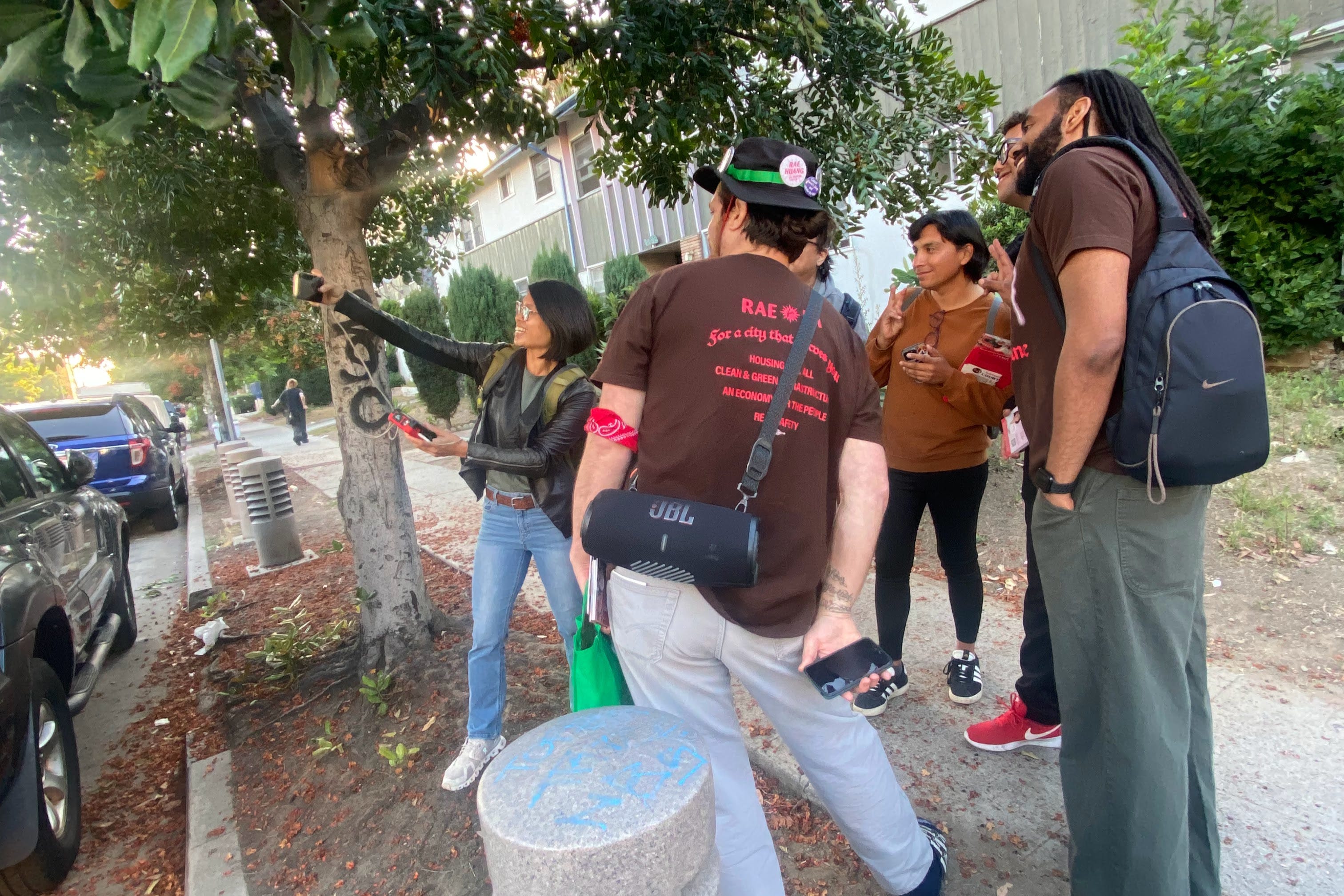
Huang’s low polling didn’t seem to faze those working or volunteering at a weekly tabling event for her campaign on Wednesday, near the Wilshire and Western Metro station. Instead, it motivated Kevin Fox, who is a volunteer captain in Koreatown for Rae Huang’s campaign. He told The LA Reporter that when he saw the polling, his first reaction was “we need to go out and talk to more people. Not enough people know about her.” He thinks the polling reflects that the mayor’s race is happening at a time when many people don’t have the luxury of time and energy to follow a local election — they’re more worried about the price of gas and groceries.
Fox first learned about Huang from seeing her in a video where she was being interviewed by Hasan Piker, someone he respects. Piker is “visceral, he speaks what you feel,” Fox said. He later saw Huang at an event of someone else he respects, Francesca Fiorentini, who does a politics podcast called the Bitchuation Room.
Growing up, Fox says, he paid attention to politics, mostly at the national level. He even used to go the local Occupy Wall Street encampment every week. His father, who came along with him, wasn’t quite as interested in politics, but he was “pissed off.” Fox said his father worked as a park ranger, and at the time his co-workers were losing their jobs and getting “thrown into the streets,” many of them having to live out of trailers.
Eventually that experience of participating in the Occupy movement did dissolve into some disappointment for Fox, because those on Wall Street never did get held accountable. But Huang entering the mayor’s race in Los Angeles, soon after a socialist, Zohran Mamdani, got elected as New York mayor, injected some hope into things. It showed “we still have people fighting — such as Rae standing up for the the people — even with everything that’s being thrown at you,” Fox said.
Even bad publicity is good publicity? Some of the work of getting the word out about Huang might ironically be done by the Los Angeles Police Protective League. The group just dropped $104,966 in ads telling people not to vote for her, even though the graphic design and tag lines feel geared rather to communicating Huang’s message to voters who do want a a Democratic Socialist — LA’s version of the very popular Zohran Mamdani in New York! — in office.
Another message saying Huang “wants to reduce the LAPD budget and divert it to unarmed crisis response” isn’t exactly a scary-sounding position for anyone to hold. Case in point, the City Council and the mayor have uncontroversially expressed support for such “unarmed crisis response” programs, including promising to expand them, albeit in reality, it has been an uphill battle to secure adequate funding for these kinds of programs.
So even though Huang is indeed supportive of defunding the police (read: reducing the LAPD’s funds in order to put them into other city services), the police officers’ union is also working to elect Mayor Karen Bass. And some think that means the union wants to fry a bigger fish by taking down one of Bass’s other opponents, Nithya Raman, who just polled at 19%. Huang is seen as taking voters away from Raman, and voters already plugged in on progressive politics have indeed been weighing which of the two candidates they’d want to vote for.
But then again, the police union may just be simply opposed to Huang. The union’s disclosure labels the ads as “opposing” Huang’s campaign, and who are we to question that?
The Olympic wage is on the skids, as LA council looks to mediate between business and labor: The Los Angeles City Council voted on Wednesday to delay the Olympic wage’s effective date for raising the wage to $30 an hour for tourism workers at airports and hotels. Council President Marqueece Harris-Dawson assured council members, six of whom voted against it, that the issue is still being negotiated and that they should expect to return to the topic at their meeting next Tuesday.
That wage was adopted last May by the City Council, but soon its future was put into question as business groups tried to qualify a ballot measure to repeal it. The repeal effort failed in September, after supporters of the wage mobilized a campaign to counter the business groups’ signature gathering. Then in December, as business groups regrouped by working to place a measure on the November ballot to repeal the city’s gross receipts business tax (a revenue source that buttresses LA city’s coffers), the council proposed changes to the wage that backpedals on the promise to provide workers with better pay, as the city hosts major events like the Olympics in 2028. That proposal primarily called for delaying the wage to 2030, two years after the Olympics.
Council members appearte to be at greater loggerheads than usual ahead of Wednesday’s vote, with the screw getting tightened by the fact that the business groups’ measure to repeal the gross receipts tax loomed.
Council member Eunisses Hernandez delivered a rousing speech on her opposition to the gutting of the Olympic wage, saying that after the wage was adopted, “people budgeted for rent, for groceries, for child care, for medical appointments, for survival, and our corporate interests want us to throw a wrench into all of that.”
Meanwhile, an effort to carve out restaurants within the hotels where the wage is set to go up, failed, despite a passionate attempt by Council member Monica Rodriguez to convince her colleagues. “I know it's not cute to allow people to be able to successfully operate a business in this city, but they are the job creators of this city,” Rodriguez said.
And Harris-Dawson, the man in the middle, described the council’s task at hand this way: "Effectively, it's our role as a council to mediate between... two opposing forces, the people who work for us and a residents of this city and the people who have businesses and who, in many cases, are residents of this city."
Canceled debate produces a mini-primer on how to interrogate candidates: Mike Bonin, director of the Pat Brown Institute and a former LA City Council member who has personally lived through the trials and tribulations of being a local elected official at City Hall, shared the questions that would have been asked by the now-canceled Fox 11 mayoral debate on Wednesday evening.
The write-up includes the rationales for why each of the questions were being posed. For example, one of the questions on immigration, according to Bonin, aims to ask about something that candidates have “largely avoided answering,” by prompting them to discuss “what happens when protecting immigrants has a direct cost to the city.” That question is, “as mayor, beyond simply declaring Los Angeles a sanctuary city, what concrete and steps would you take to protect undocumented residents in their daily lives — and how will you respond if the federal government starts to pull funding from the LAPD or LAFD?”
Bonin also shares one of the goals they had in their debate, which was to “avoid questions with obvious, pre-packaged answers. Candidates have talking points ready for the easy setups. We wanted questions designed to get past those talking points.”
One person who responded to Bonin’s post on Substack responded saying, “really insightful to read these, even from the perspective of learning how to interrogate and understand candidates’ positions. A shame it’s not happening. Thanks for sharing these!”
Something I missed … The LA Times also did a write-up Tuesday on Marta Segura, the city’s chief heat officer, getting let go, after it was reported by Sammy Roth of the Climate Colored Goggles. It includes a round-up of the numerous departures of people at City Hall that were working on sustainability issues, and it’s worth reading for its overview of the state of sustainability action at City Hall: Other recent departures include Janisse Quiñones, who resigned as the head of the Los Angeles Department of Water and Power in March; Barbara Romero, who stepped down as head of the city’s Bureau of Sanitation in October amid rumors that she was pushed out; and Nancy Sutley, deputy mayor for Energy and Sustainability, who retired. All were advocates for clean energy and sustainability goals.

