


What’s happening today?
Powerful political figure to be taken up by Measure G task force this afternoon, as some worry their access to LA County government could be weakened
The task force that’s guiding the implementation of Measure G is set to make some decisions today around the role of a newly created elected leader in Los Angeles County government. This elected political figure could have widespread power over many social safety-net departments such as the Department of Public Health, as well as the LA County Sheriff’s Department. The county government also oversees municipal services in unincorporated pockets of the county, such as unincorporated East Los Angeles. You can find the agenda for their 5 p.m. meeting, including reports detailing the discussion so far, here.
On this topic, journalist Robert Greene has a piece out this week at Los Angeles Rules, that looks at a recent meeting in which groups representing cities throughout the county, and community organizers who have been trying to make the political process fairer to more people in Los Angeles, shared similar worries that the progress they’ve made building their relationship and knowledge around a county government led by a board of supervisors, could be weakened with the incoming elected County Executive.
Greene writes that those sometimes politically divergent players are “concerned that the Measure G requirement to create an elected county executive with direct authority over most county departments will break the access to the county that they have gained through studying the intricacies of a county system with the Board of Supervisors in charge, and through the relationships they have developed with each supervisor and their staffs.”
Some of the community organizers, for example, have had success in 2019 and 2020 in getting to the Board of Supervisors “to scrap a new jail, make anti-racism a priority in all county programs, and send voters Measure J, a charter amendment that requires a spending floor for alternatives to incarceration, including employment, training, mental healthcare, and other programs,” Greene writes.
A ‘no-cost Olympics’ could turn into a ‘very expensive Olympics’ due to LAPD vehicle requests, an LA council member says
The LA City Council signed off today on authorizing $13 million in debt to finance 107 LAPD vehicles to use for the 2028 Olympics, but Council member Eunisses Hernandez said this could be the start of potentially more costs for the city, amounting to as much as $44 million, despite the Games initially being advertised as being no-cost for taxpayers.
Hernandez, who was one of three council members who opposed authorizing the $13 million in vehicle financing today, said it could just be the first of several expenditures that could turn “a no-cost Olympics” into a “very expensive Olympics.”
“You cannot tell Angelenos you are getting a no-cost Olympics, then come back expense-by-expense, and tell us the city has to pay because the Olympics are coming,” Hernandez said, before urging all of her colleagues to reject saddling themselves with the $13 million in debt. All of the council members present ended up voting to move ahead with it, with the exception of Hernandez, Ysabel Jurado and Nithya Raman. Council members Bob Blumenfield, John Lee, Monica Rodriguez and Hugo Soto-Martinez were absent for the vote.
The funding for the vehicles that got approved for financing today had already been approved during the LA city leaders’ budget process earlier this year. Those vehicles will be used to “support investigations, special operations, event logistics, event management, and incident response across the venues, and are operational tools rather than transportation assets,” according to a July report by LAPD officials.
LA leaders appear to be waiting and seeing if requests for an additional 300 LAPD vehicles – whether they end up being patrol or emergency response SUVs – that could ultimately raise the costs to $44 million can be reimbursed by state or federal agencies or even LA 28, the privately run coordinating committee for the 2028 Olympics. For now, LA 28 has told the city that they haven’t set aside any funding for law enforcement in their budget, although city officials are saying that might be worked out eventually through the venue services agreements that still need to be negotiated and inked with LA 28.
Council member Katy Yaroslavsky, who chairs the Budget and Finance Committee, said at an Aug. 18 committee meeting that she wanted to see if the governor would declare a state of emergency in order to release state funding to purchase those vehicles. There was also discussion around whether they could argue that the federal government would need to reimburse them, after the Secret Service recently told the vehicles that the vehicles are necessary to counter drone activity during the games.
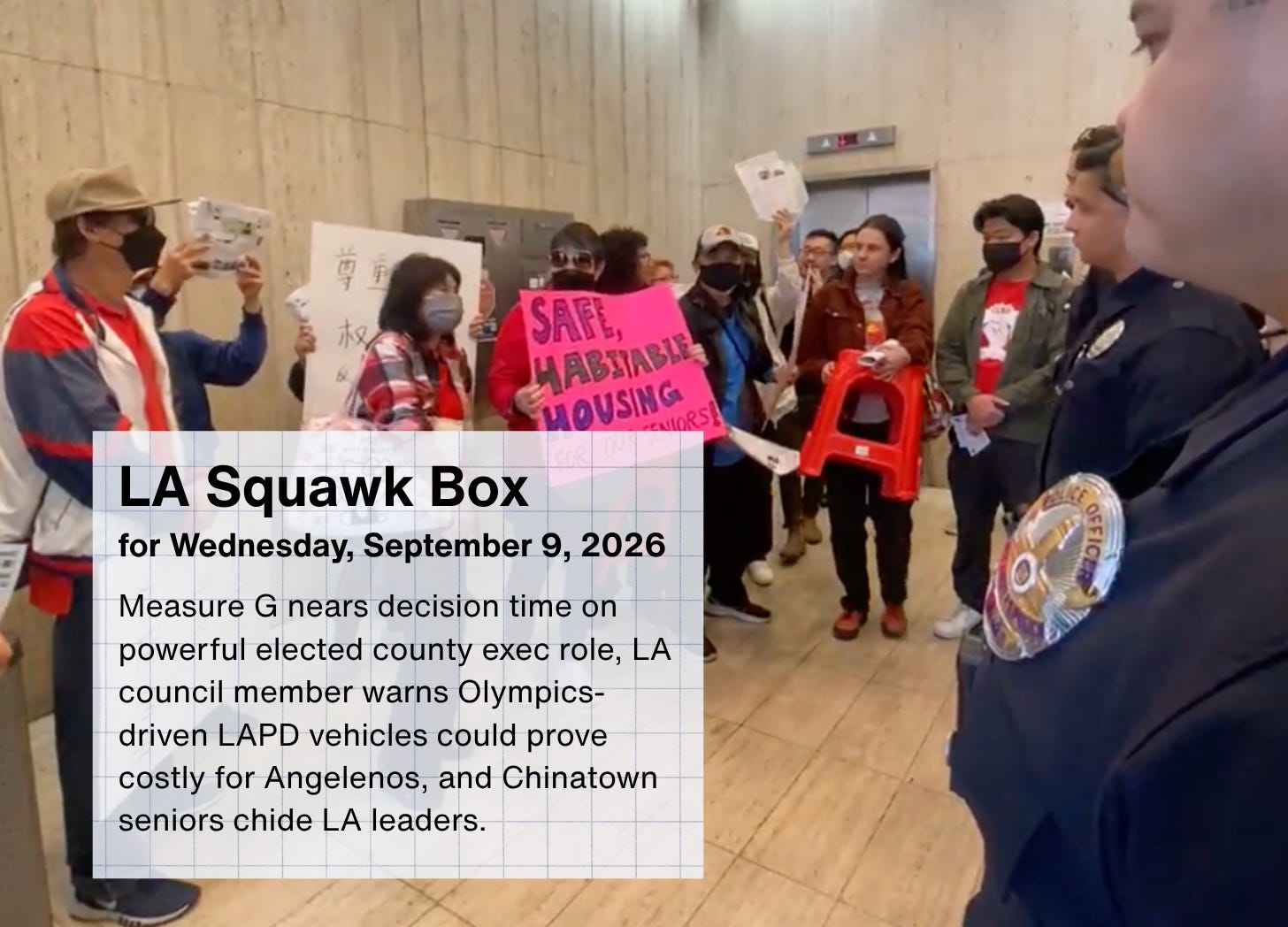
As LA leaders fuss over LAPD vehicles, some elderly Chinatown residents scold them for spending public funds on the wrong things
That vote to have the city carry $13 million in debt to pay for LAPD vehicles for the 2028 Olympics was also the focus of a group of mostly elderly Chinatown tenants, who took to LA City Hall today urge them not to throw money at such things as LAPD vehicles, but to instead direct available funds toward low-income tenants who are facing rent increases.
“We work so hard for the majority of our lives, and to be able to peacefully have a place to sleep at night is something that is becoming increasingly more impossible,” one Chinatown resident told the City Council during public comment today through a translator standing beside him.
Many tenants have been saying for months now that the existing rents at their Chinatown buildings are already more than they can currently handle, and they are expecting further increases due to policy decisions by local leaders, as soon as this fall. The group is carrying out a “Raise Income, Not Rent” campaign that they launched earlier this year to get their local representatives on the City Council and in city government to advocate for them, including at the state level where legislative changes need to be made to address their concerns. Today, they said in a press release from the volunteer organizing group, CCEDLA, that “rather than set aside a $13 million budget proposal for the Los Angeles Police Department (LAPD), Chinatown tenants demand that elected officials:
“1. Find a long term solution to protect all tenants, including: a reform of the regulations to cap rent increases for affordable units, and include provisions that limit what landlords can charge for utilities and other fees.
2. Issue a rent freeze for all affordable housing until a long term solution is found.
3. Immediate rental assistance to cover the upcoming rent increases and keep low income tenants housed in all affordable units.”
What just happened?
There was a candidate forum between Council District 3 candidates Tim Gaspar and Barri Worth Girvan last night. For now, you can view an archived livestream of it here, although I’ll be asking about a possible recording of the Zoom stream. If they have it, I”ll share it.