


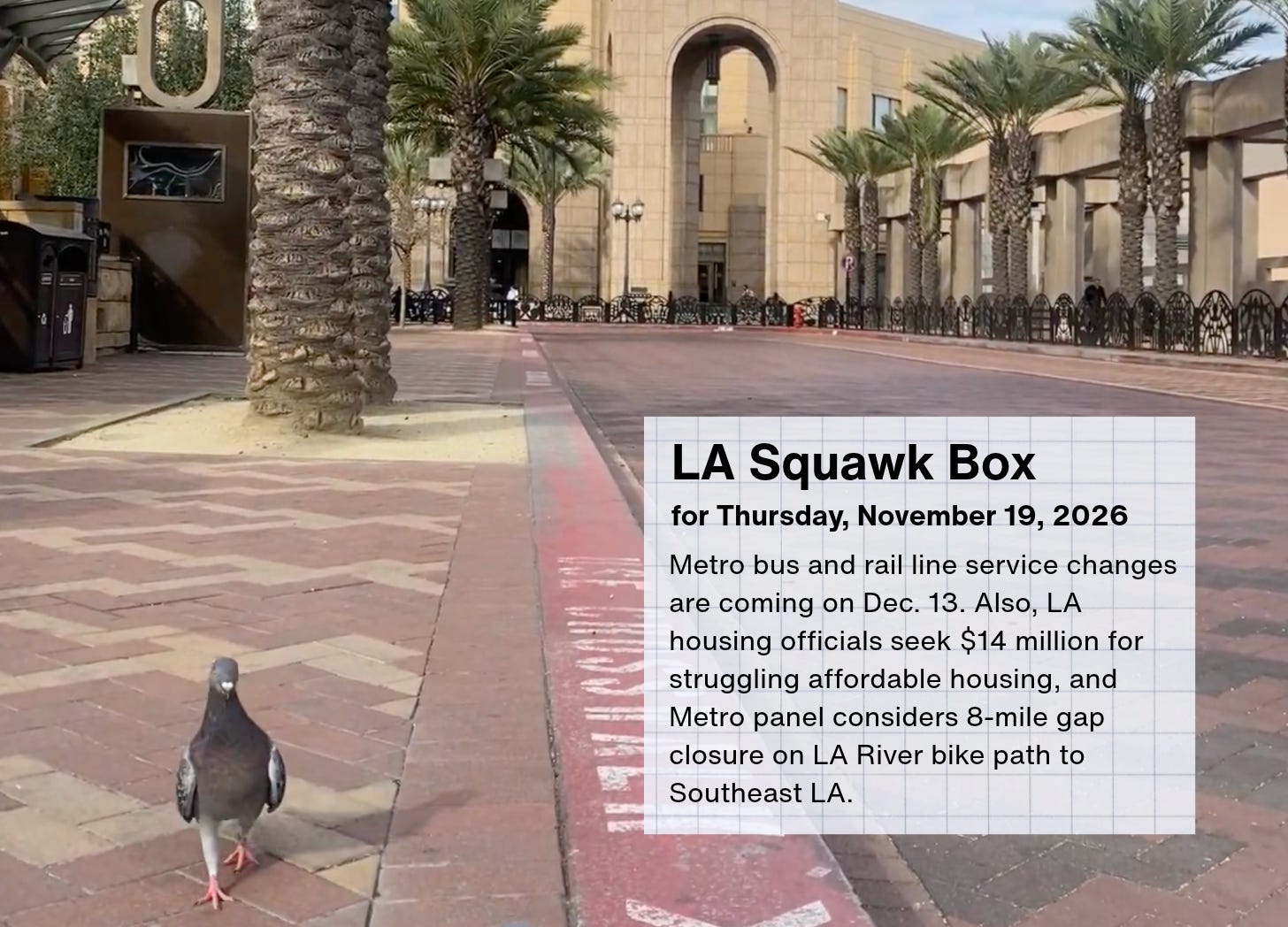
What’s happening today?
☔ A storm threatens to flood parts of LA county. County officials have issued evacuation warnings. Late add: LA County Supervisor Janice Hahn has been giving updates on the flooding at Harry Bridges Boulevard.
🗳️ The LA County Registrar-Recorder/County Clerk is scheduled to release another election update, as LA’s 9th City Council District race remains close.
What’s squawking: 📽️ An economic analysis of LA County’s film, TV and digital production industry: Agenda / Teams // ♿ Disability commissioners take up workplan, Measure ULA program: Agenda / Zoom // 🚃 Metro reviews its share of the troubled Metrolink budget: Agenda / Granicus // 🚧 Keeping traffic flowing during Metro transit projects: Agenda / Granicus // 🚲 Closing the 8-mile Lincoln Heights to Southeast LA LA River gap: Agenda / Granicus // 🚌 Bus and rail services changes are coming on Dec. 13: Agenda // 👮 Metro security officer contract extension: Agenda // 🌊 Cancelling Measure W stormwater capture projects in Eagle Rock, South LA: Agenda
A bit more about what’s on the squawk box:
📽️ LA county officials will be discussing what’s happening with film, TV and digital production – now lumped under the name “the screen industry” – at a “cluster” meeting starting at 2:30 p.m. They’re reviewing an economic analysis of how production activity for theatrical film, traditional television and vertical and digital production activity “sustains regional employers, skilled workers, and local suppliers.” The analysis looks at shrinking production, where productions are going — and it gets into what county officials can do about it. The report is included with the agenda packet.
♿ LA city’s disability commissioners are reviewing their work plan, and getting a presentation on an “income support program” that’s funded by revenue from Measure ULA, a tax on the sale and transfer of high-valued real estate. The meeting is at 2 p.m., and a large print version of the agenda pdf can be found here.
🚃 Now that Metrolink has received a last minute infusion of $20 million in state funding – and is no longer in danger of being forced to cut services, at least for now – the Metro board and other members of the joint powers authority should be ready to move forward with reviewing and approving their portion of the budget for the commuter rail agency. The Metro board’s Finance, Budget and Audit Committee met at 10 a.m. and took up an item that calls for approving their portion of Metrolink’s budget. Each of the five member agencies for Metrolink has to approve their own share of the budget, and Metro’s share makes up about 52%. Of note is that this Metrolink budget item had been scheduled for October but was pulled in order to await funding news from CalSTA that was imminent at the time. Metrolink had been looking at a deficit and would have needed to drastically cut service, if not for the $20 million in funding that was just announced by CalSTA, and that ws awarded to “avoid proposed service cuts and keep Southern California’s regional rail network running ahead of the LA28 Olympic and Paralympic Games.” One of the committee’s members, LA City Council member Katy Yaroslavsky, cited the Metrolink CEO recently stepping down, and asked whether they should worry about any future fiscal troubles. “I think it is just a necessity,” a transit official said in their response to Yaroslavsky. “We have to have better fiscal discipline.”
🚧 Amid the numerous Metro projects — many in the city of Los Angeles — there’s now a plan to try to speed up the process, at least when it comes to getting approvals for redirecting LA city traffic around construction zones. The Metro board’s Executive Management Committee began meeting at 11 a.m. and was expected to discuss an amendment to a “master” agreement between the city and Metro that gives the transit agency a bit more leeway — the terms would require that Metro submit a traffic control plan, but Metro wouldn’t need to get the Los Angeles Department of Transportation’s approval for every piece of traffic control signage they want to put into the roadway.
🚲 The Metro board’s Executive Management Committee is also scheduled at its 11 a.m. meeting to decide on a preferred project plan for closing an 8-mile gap in the Los Angeles River bike path, between Riverside Drive and Atlantic Boulevard. The proposed path would cut through Lincoln Heights, near Albion Park, run between the Arts District and Boyle Heights, travel through an industrial area surrounded by Vernon and Commerce, and get into the Southeast Los Angeles section of the LA River that flows around Maywood and Bell.
🚌 Some bus and rail service changes are set to go into effect for Dec. 13, including an increase to the frequency of Metro’s B Line weekday early morning trains that are being made to help commuters make it to work on time. Those trains are now scheduled to every 20 minutes, but will arrive every 15 minutes, under the change. The Metro board’s operations committee is scheduled to go over the full set of changes at their 1 p.m. meeting. Other changes increase rides that serve students trying to get to school on time, while other service will get reduced, including for the bus rapid line on Wilshire Boulevard, Line 720, in response to the new D Line extension that added a rail route option for people traveling from Koreatown to Wilshire/La Cienega in Beverly Hills.
👮 And the security companies that Metro hired to patrol rail and bus lines, train stations, parking lots and other Metro infrastructure are up for an extension to their contracts, to June 2027. That proposed extension is being reviewed at the 1 p.m. Metro operations committee meeting.
🌊 The Measure W Oversight Committee was set to review, at its 10 a.m. meeting, a report by the Bureau of Street Services sharing plans to withdraw two projects — one in Eagle Rock and another in South Los Angeles — to capture stormwater. The Eagle Rock project was to create an filtration system. It also included widening a median and adding native trees that would add shade to the area. And work on the stormwater capture portion of the other project in South Los Angeles, the Broadway-Manchester Multi-Modal Green Streets Project, also halted on Oct. 13, after it “experienced substantial cost escalations and schedule delays resulting from COVID-19 impacts, complex utility realignments, and general project complexity, preventing completion under the current SCWP framework.” The plan is to return the money awarded via the county’s measure W program.
What just happened?
LA housing department on alert over troubled affordable housing: LA city housing department officials have a watchlist of more than 200 struggling affordable housing projects, and as part of that, they are seeking about $14 million from local funds allocated for “trouble assets” to assist eight of the projects that are at risk of foreclosure. They gave a presentation to the LA City Council’s Housing Committee on Wednesday. You can catch that discussion here.
Retrofits for Chinatown’s Bartlett Hill Manor affordable housing development: And LA city housing officials are also seeking authorization to give out a loan to help make accessibility retrofits at Bartlett Hill Manor, an affordable housing development in Chinatown.
‘Measure G’ task force focuses on revamping LA county’s legislative process: The task force that’s helping to implement Measure G held a special meeting on Wednesday that focuses on developing a new legislative process, and the creation of a legislative analyst office at the county.
LA city leaders considering bring in ‘smart’ tech to manage loading zones: The Los Angeles City Council’s Transportation Committee on Wednesday went over a proposed pilot program to use “smart loading zone” technology that transportation department officials say is meant to help “reduce illegal parking, increase curb turnover for local businesses, reduce emissions, as well as improve safety for pedestrians, cyclists and drivers.” LA city transportation officials are proposing to do a pilot that would involve working with private companies that offer those tech services. A report from the department proposes that the city might do this by amending an existing “mobility hub” contract the city has with the company, Tranzito. The transportation department’s report describes “smart loading zones” as a “technology-driven solution that transforms unmetered loading zones into revenue-generating managed assets,” and it also says that the technology uses “video-imaging sensors and automated license plate recognition technology” that tracks what vehicles and doing and how long they are hanging around. The report goes over examples of how cities like Pittsburgh, Oakland and Miami have implemented so-called “smart loading zone” tech.
A few more things…
The LA Times’s James Rainey reports that LAPD Chief Jim McDonnell says it will cost between $3.5 billion to $4 billion to cover police costs during the Olympics.
LA County Supervisor Kathryn Barger, Assembly member Pilar Schiavo and Rep. George T. Whitesides have sent a letter to the EPA requesting that the federal agency force the operator of the Chiquita Canyon Landfill – which earlier this week experienced an explosion in a gas pocket in the landfill that spewed out noxious fumes and rotting garbage – to increase their relief measures for the surrounding communities. The elected officials wrote that they had just learned the landfill has offered 80 hotel rooms, even as there are 1,200 households nearby that are affected by the explosion.