


What’s happening today?
We’re being advised of another heat wave this week. And big storms on the horizon as we head into a potentially ‘very strong’ super El Niño season. The National Weather Service issued yet another extreme heat advisory, this time for Tuesday, July 14 until Thursday, July 16. Check out the LA County Department of Public Health’s website for some resources and information about the heat wave. And reporter Rong-Gong Lin II breaks down the incoming El Niño for the LA Times.
Police commission to take up LAPD’s contracts with Flock and other surveillance camera companies
The Los Angeles Police Department’s partnerships with digital surveillance companies like Flock are being taken up at today’s meeting of the Board of Police Commissioners, a panel of mayoral appointees that provides “citizen” oversight of the LAPD. The inspector general has raised concerns about whether agreements with Flock and other companies really contain safeguards around the security of the data the “automated license plate reader” cameras pick up.
There’s have been heightened concern around these cameras due to reports that the federal government, including immigration officials, have gotten access to the data Flock collects, amid President Donald Trump’s aggressive immigration raids. But another notable concern that comes with these cameras is that they may lead to unnecessary police enforcement. The inspector general’s report being taken up at today’s meeting says that the independent watchdog looked at the period of August and September of last year and found that 161 of the alerts that the license plate readers sent to law enforcement ended up being for vehicles that weren’t stolen. The report also found that some of the alerts led to police pursuits.
Meanwhile, these cameras are typically advertised as being able to help police apprehend suspects especially for property crime, and mostly around stolen vehicles. And there were indeed more than 300 stolen vehicles recovered in the two months the inspector general examined. The cameras are also used to track down suspects in other types of crime.
According to the inspector general’s report, there are some questions as to how clear the data security language is in the agreements the department does or did have with the companies that operate the cameras. And they also point to some cameras that still lack contracts which address those issues. They’re calling for the department to put a pause on getting into an new contracts or installing more cameras, at least until the department has gotten public input and worked out these data security details. Department officials are also set to give a verbal report on the topic.
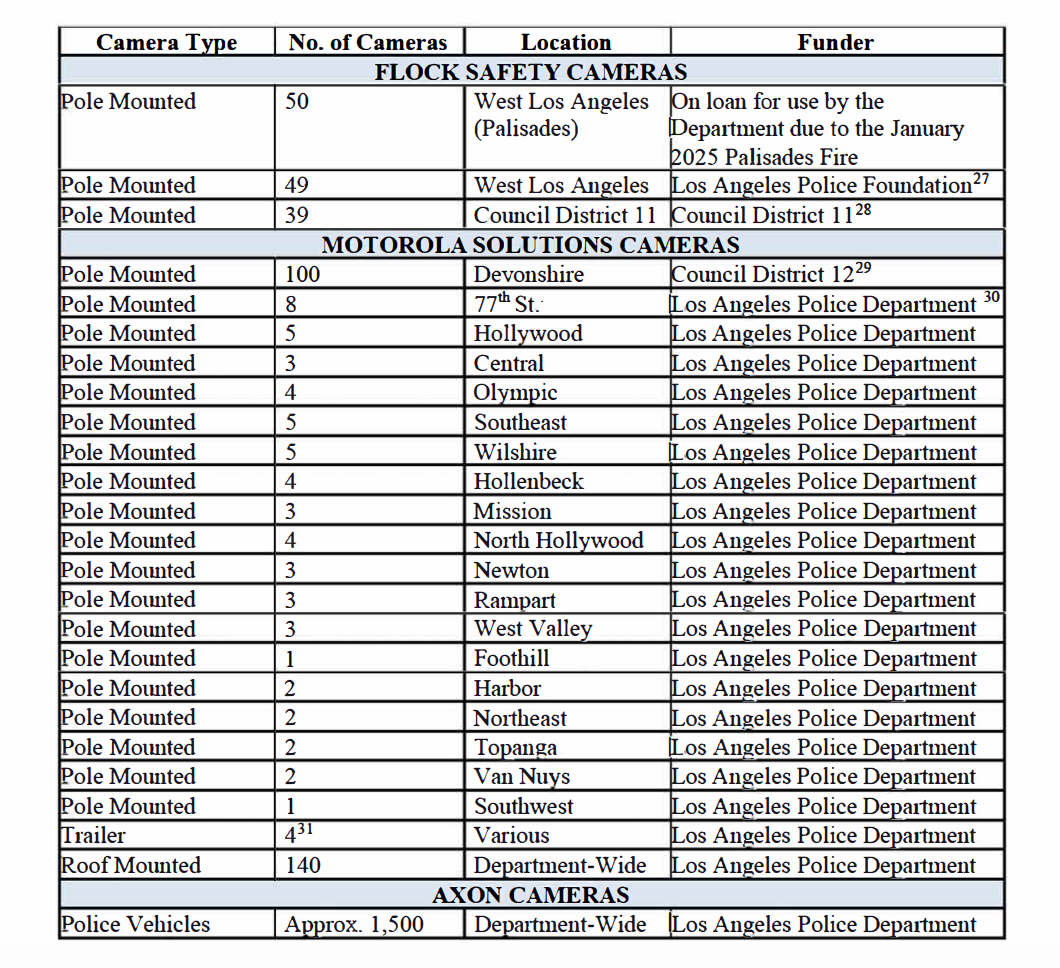
There are more than 200 cameras mounted onto polls around the city that can pick up license plate numbers, record the time and location of where that information was picked up, and then input that information into a searchable database for law enforcement officials to use. A good portion of those cameras are operated Flock, but many others are operated by Motorola, which offers a similar service. Another company, called Axon, that’s better known for providing body-worn cameras, tasers and the digital cameras inside of police vehicles, works with Flock to be able to allow LAPD officials to search license plate information from the images they pick up. Axon actually has 1,500 cameras on the police vehicles that rove about the city. The OIG’s report points to how it’s unclear what Flock might be doing with the data that it helps Axon make searchable.
The report also breaks down where those cameras are located and what company operates them, as well as who provided the funding for them. For example, not all of the cameras were purchased by the LAPD. Some were donated via the Los Angeles Police Foundation, on behalf of homeowners associations that paid for them, many of them on the westside. Once the donated cameras are put into place though, the department has set aside funding for them, and that’s what LAPD officials did on several of the occasions. Meanwhile, some council districts have used their own discretionary funds to pay for cameras to be installed, including Council member John Lee’s 12th District, which issued a $496,949 purchase order for 100 pole-mounted cameras operated by Motorola Solutions. The department also got 50 cameras loaned to them in the Pacific Palisades area after the wildfires, after concerns were raised about possible looting happening there.
The data security concerns now being raised by some LAPD officials appear to have led to the contract with Flock expiring this past Saturday, but some advocates who have led a steady drumbeat over the years about police surveillance programs say they faced obstacles in getting a close look at those agreements. Stop LAPD Spying sued the department in May to obtain records about the relationship between Flock and other similar companies. The department ended up coughing up some records dating back to 2019. In their lawsuit, Stop LAPD Spying noted that even as department officials were promising a report, those contracts and records weren’t being made readily available to the public. In the complaint, the group warned that if the department continued to delay or not respond to their request, “then LAPD will have defied the Public Records Act to ensure a highly one-sided debate on a time-sensitive matter of urgent public concern.”
Flock tends to get most of the attention of the different companies that operate cameras as part of the city’s “automated license plate reader” system. The company does have a lobbyist who is familiar to many at City Hall — former City Council member Joe Buscaino, who also worked as an Los Angeles Police Department officer.
Amidst all this, City Council member Ysabel Jurado actually introduced a motion in late May to get more information about the city’s relationship with Flock and other similar companies, and it’s been assigned to the Public Safety Committee that’s chaired by Lee, whose district was the one that paid to install 100 of the cameras in the LAPD’s Devonshire Division that covers the northwest San Fernando Valley. As chair, Lee is in charge of scheduling motions to be taken up in the Public Safety Committee where Jurado’s motions sits. As of this morning, there’s no date yet for when that motion would be taken up.
What just happened?
It’s one big city family, as City Hall veteran advises both Lineage and Mayor Bass
It’s like that meme of the different Spider-Man pointing at each other. As Mayor Karen Bass sought to get tough on executives of Lineage, an unpaid communications adviser and spokesperson of hers was at the same time working for that company, which had a cold storage warehouse in Boyle Heights catch fire last month. The fire’s effects and elected officials response to it have been generating no small amount of outrage in the surrounding community.
Yusef Robb, who has worked for two previous mayoral administrations, has been been an unpaid adviser to Mayor Karen Bass since at least January of this year, around the time her office was experiencing some turnover on their communications team — first with her longtime communications adviser Zach Seidl leaving, and then his replacement Amanda Crumley also departing three months later. But then, Robb started doing crisis communications work for Lineage last month, through his own firm tk/Communications. This news was first reported by LA Material’s Julia Wick, with the LA Times’ team quickly following with their own report on this.
Both articles include comment from ethics experts, with Wick going to Jessica Levinson, and the Times to Sara Sadhwani, for remarks about whether it’s wise for Robb to be serving competing interests. Wick’s article notes that Robb also advised Bass in an unpaid capacity back in 2022, when Bass was running for office, and then was paid after she took office. The mayor’s office had told Wick that a “firewall” was in place, which meant that Robb wasn’t working on the Lineage fire while also advising the mayor. They said something similar to the Times. Robb told the outlets after the news broke that he’s decided to cut off his advice to the mayor.
Meanwhile, Lineage has tended to try to cultivate access at LA City Hall, having spent in the six figures to lobby city departments for the last year and a half or more on issues around the solar panels on their roof that they’re now blaming for the fire happening. And Lineage’s co-founder Kevin Marchetti has donated to LA city electeds, including Eric Garcetti and the current mayor. So, the company appears now to be ensconced amongst the “city family” folk. The main crisis communications company working for Lineage, M Strategic Communications, is led by Shannon Murphy, previously communications director to Mayor James Hahn, before she went to work for Bass and John Perez in the State Assembly. Murphy also held a stint in Wendy Greuel’s administration in the City Controller’s Office. The other principal at M Strategic Communications, Chris Modrzejewski, was a top level staffer for Mayor Richard Riordan.
And last Thursday, while getting skewered by audience members at a community meeting in Boyle Heights, Lineage’s chief operating officer, Jeff Rivera, shared a story about how their CEO getting onto the phone with the mayor when the fire started. The mayor had recommended that they provide money to the California Community Foundation to distribute to local groups.
Group that did fundraising for the L.A. Zoo for more than 50 years is now bankrupt
The LA Times’s On the Record newsletter offered up some news about the LA Zoo’s former fundraising arm, GLAZA, going bankrupt, amid an acrimonious fight over who gets to handle $50 million endowed to the zoo. GLAZA raised money for the Zoo for over 50 years, before their contract with the city ended last year. The Times recently had a story, from Ruben Vives, about a civil grand jury’s recommendation that the Zoo should set up a new public-private partnership. The report pointed to other partnerships they considered successful, such as those that have bolstered the Los Angeles County Museum of Art and the Natural History Museum.
Major players fought over plan to turn dirt lot across from City Hall into art park, with some questioning how that path was paved
Noah Goldberg of the LA Times has a story on the fight among power players that went on behind a plan to put an “art park” on the big dirt lot next to LA City Hall that’s sat empty since the 1970s. The 13-story state building that was there before was torn down after it was deemed structurally unsafe following the 1971 Sylmar earthquake. There is a plan right now for AltaMed, a health group that focuses on the Latino community, to create an “art park” on the lot. But the plan had faced an appeal from SEIU 721, which represents public sector workers including city workers, before the City Council rejected the appeal, allowing the project to move forward. The article notes that at the state level, their sister union, SEIU-UHWW, hasn’t gotten along with AltaMed, whose workers aren’t unionized. And the article also points to AltaMed’s cosiness with the city’s elected officials, including the group’s chief executive, Cástulo de la Rocha, who served on Bass’s transition team in 2022. De la Rocha and other AltaMed executives have contributed the maximum $1,800 to Bass’s re-election campaign, totaling $34,000. Meanwhile, a downtown Los Angeles residential group, the Downtown LA Residents Association (also referred to as DTLA RA), has been raising concerns about how it seems as though the plans were made behind closed doors and they’ve been advocating for transparency about how the park will be used. And some history about this dirt lot. The dirt lot was initially purchased by the city in 2013 to be turned into a park, under then mayor Antonio Villaraigosa’s 50 Parks Initiative. In 2016, when Council member Jose Huizar was the area’s representative, he had announced that Mia Lehrer & Associates had been picked to design the park, following a competition. The plan at the time was to complete the park by 2019, and $20 million had apparently been set aside for building the park. Then in 2023 after funds were switched over to pay for building the Sixth Street Viaduct, that park project was put on hold.
CalMatters breaks down effect of federal housing bill to increase housing production in local cities like Los Angeles
A federal bill that President Donald Trump fought hard against, but that ended up passing and going into effect, will lead to the Community Development Block Grant funds getting cut by 10% if cities don’t build housing fast enough, a change that an expert with UC Berkeley told CalMatters will likely affect cities like Los Angeles and San Francisco. According to CalMatters’ reporting, LA city received $48.4 million in CDBG funds in 2024. State legislation often encourages housing construction, but they haven’t actually punished cities for failing to grow their housing stock, according to CalMatters.
Interestingly, the bill got plaudits rather than pushback from a local government group, the National League of Cities. Another part of the bill increases the number of permits given to public housing authorities to use on a program called rental assistance demonstration program (RAD) to fund repairs of aging public housing buildings. There is some debate over this program being expanded, however. The National Low Income Housing Coalition opposes its expansion because of concerns it would weaken tenant protections. CalMatters points to a study that they say doesn’t show it leads to more evictions, although this metric doesn’t necessarily speak to other types of tenant protections specifically.
A few more things…
District Attorney Nathan Hochman announced that his office secured a $320,000 settlement from Langham Hotels in a price gouging lawsuit related to the 2025 wildfires.
Gov. Gavin Newsom celebrated his signing of AB 179, which provides funding and makes policy changes aimed at increasing housing production. This bill includes $900 million for a state funding program to fund housing for people who are unhoused, called HHAP, that that already fund projects in Los Angeles. There’s also $500 million for the LIHTC (low-income housing tax credit) program and $200 million for building and preserving affordable low-income apartments. This bill has been in the news because it makes changes to how local governments can charge “impact fees” on affordable housing. Those are extra charges on developers to cover infrastructure costs and municipal services.
And the LA City Clerk just put out a call for ballot arguments on these eight measures headed to the November ballot:
Property Transfer Tax Exemption for Victims of January 2025 Fire Disaster (Proposition TE)
City Infrastructure Budget, Finance, and Contracting (Charter Amendment LA)
City Planning Department (Charter Amendment PL)
City Ethics, Elections, and Governance (Charter Amendment EE)
City Department of Recreation and Parks Budget (Charter Amendment PRK)
City Airports, Harbor, and Water and Power Departments (Charter Amendment PRT)
Campaign Finance Rules Related to Board of Education Elections (Charter Amendment SC)
Funding for the Los Angeles Fire Department through a One-Half Percent Sales Tax (Initiative Ordinance FD)
More information about submitting these arguments, which are due July 31, can be found here.


I just need to say that this is my favorite place to get daily news about LA!! Thanks for continuing to cover so many stories that I am already interested in and bringing new ones to my attention. This is the kind of regular reporting that LA deserves!! 🙌👏
The tents that lined that dirt lot were used in the LA Alliance case as evidence of systemic failures in homelessness policy. @Ruth